


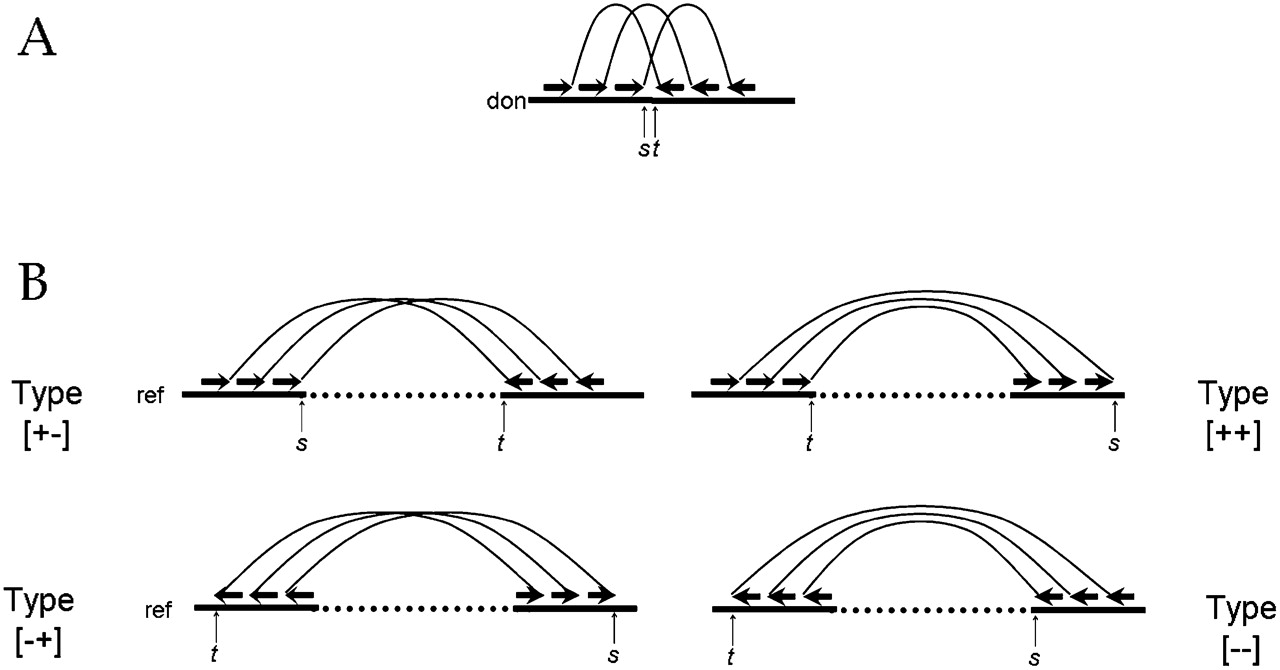
Figure 3.
Clustering. (A) A cluster originates in the donor, where the mate pairs of the cluster are all of those that span a given location. The innermost positions of this cluster, specified by s and t, are (nearly) adjacent. If this adjacency doesn't exist in the reference, then the cluster will map discordantly. Nevertheless, all of the mate pairs within the cluster will have a similar mapped distance, order, and orientation. There are four distinct types of clusters, based on the order and orientation of the mate pair mappings, as shown in B. In each case, we can identify the locations s and t in the reference, and mark them as a putative adjacency in the donor.



