


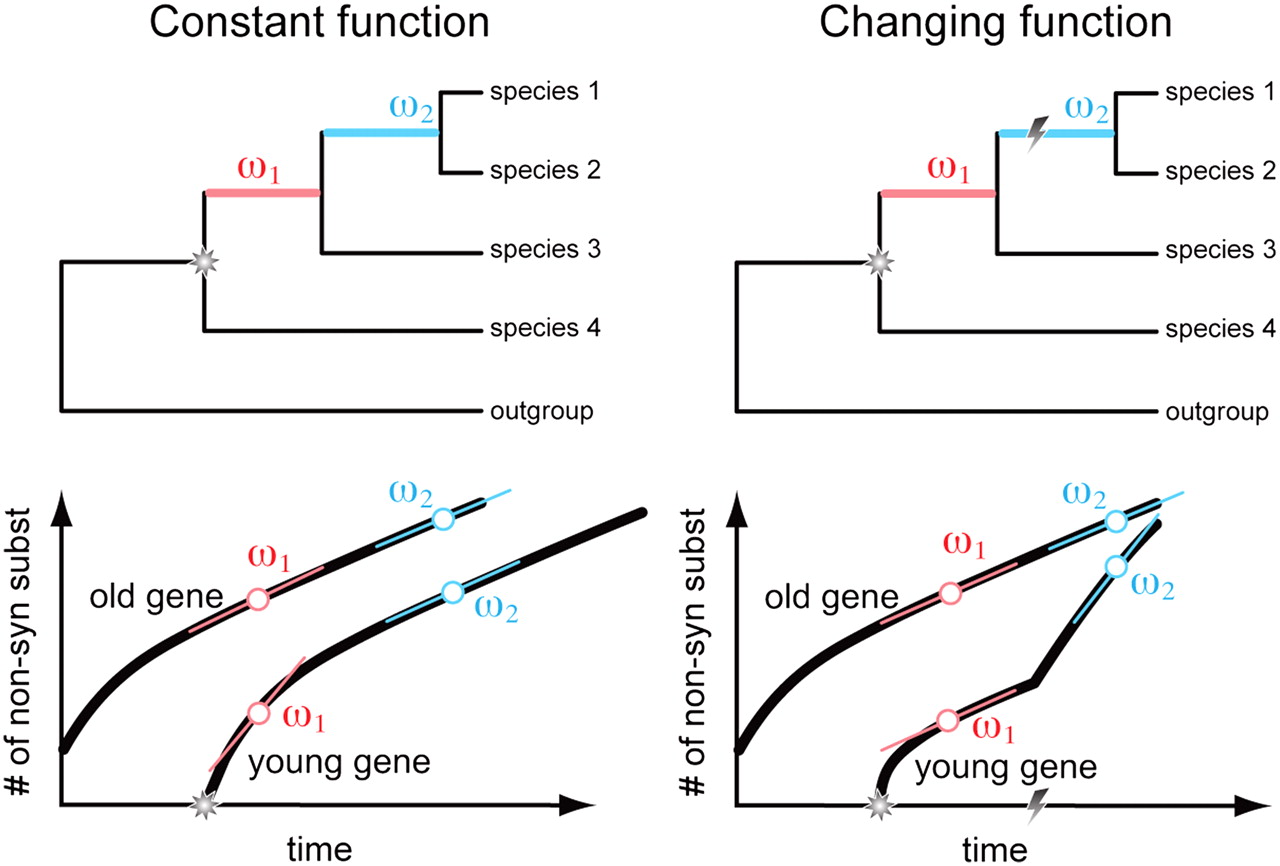
According to conceptual models of protein evolution, young genes experience more variable selection pressures over time than old genes. The two examples shown here illustrate a young gene that arose at the common ancestor of species 1–4 (stars), compared with an old gene that arose in the distant past. (Bottom) The cumulative number of nonsynonymous substitutions over time, the slope of which is proportional to the dN/dS value. If the young gene retains its original function (left), it rapidly depletes adaptive sites, resulting in a dramatic slowdown in the nonsynonymous substitution rate: ω2 < ω1. If the young gene experiences a functional change in a lineage (either relaxed constraint or neofunctionalization; right), as indicated by a lighting bolt, it rapidly accumulates nonsynonymous substitutions, resulting in ω2 > ω1. In both cases the young gene experiences variable selection pressures (i.e., large |ω1 – ω2|), whereas the old gene experiences roughly the same selection pressure in recent times, because it retains its function and most of its adaptive sites have already been depleted: ω2 ≈ ω1.


