


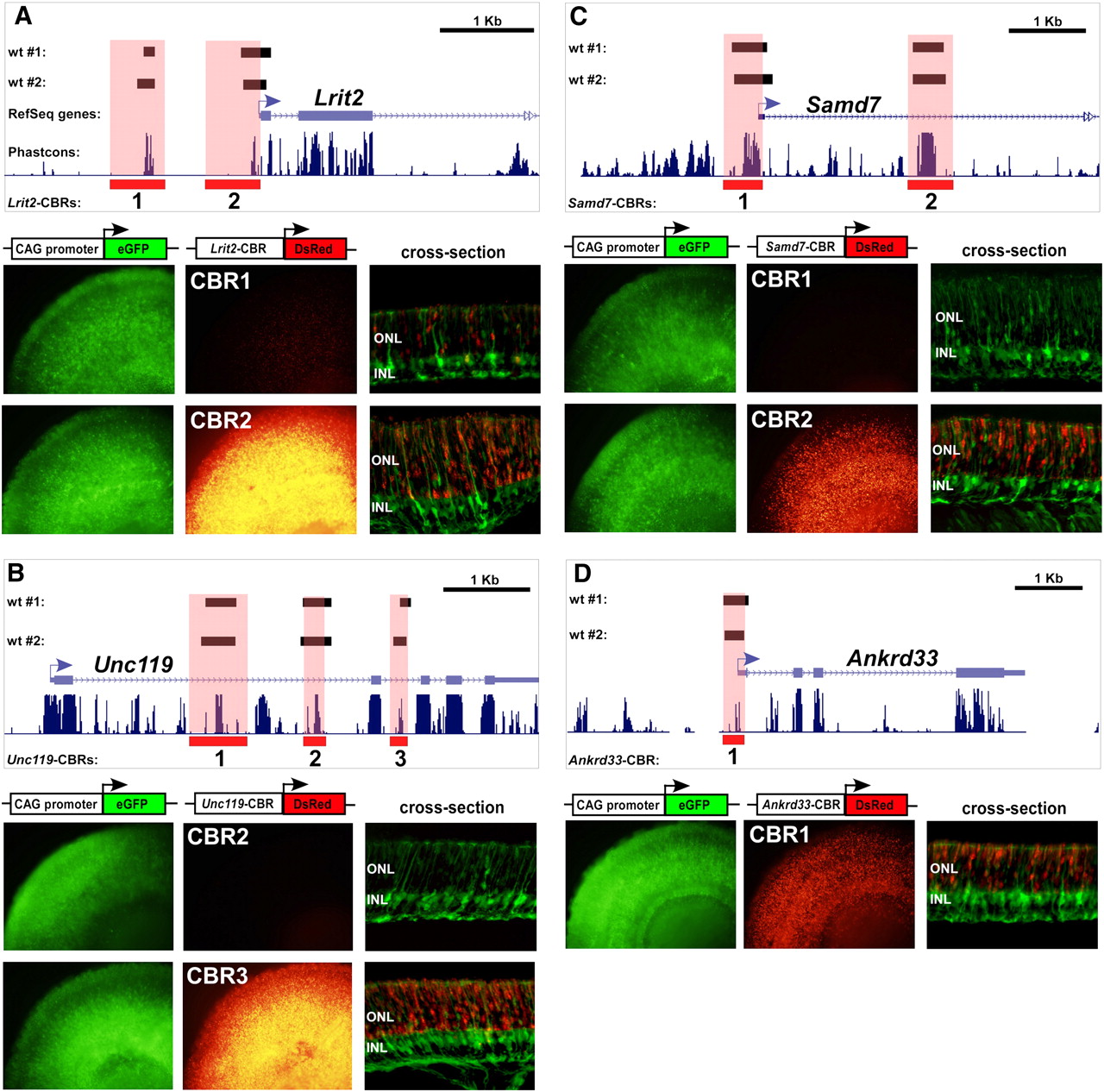
CRX-bound regions are photoreceptor-specific cis-regulatory elements. (A) The CBRs around a novel photoreceptor-enriched gene, Lrit2, act as photoreceptor-specific cis-regulatory elements. There are two CBRs within the first 2 kb upstream of the transcription start site that were bound in both CRX ChIP-seq replicates from wild-type retinas (“wt #1” and “wt #2”). PCR products encompassing these CBRs (highlighted in light red) were cloned into a DsRed reporter construct and co-electroporated along with a ubiquitously expressing CAG promoter into explanted P0 mouse retinas. The retinas were grown for 8 d and then imaged in both red and green channels in flat-mount and as cross-sections. All flat-mount images in this figure were exposed for the same length of time to permit comparison of the strength of expression. (B) CBRs around a known photoreceptor gene, Unc119, which, when mutated in humans, results in cone-rod dystrophy. Unc119-CBR1 was shown previously to drive strong photoreceptor-specific expression in electroporated retinas (Hsiau et al. 2007). Unc119-CBR3 also drives strong photoreceptor expression, whereas Unc119-CBR2 does not. (C) CBRs around another novel photoreceptor-enriched gene, Samd7. Samd7-CBR2 drives strong, photoreceptor-specific expression, whereas Samd7-CBR1 does not. (D) CBR around a photoreceptor-enriched gene, Ankrd33, which has recently been shown to inhibit the DNA-binding activity of CRX (Sanuki et al. 2010). Only a single CBR was found in the vicinity of Ankrd33. It shows strong photoreceptor-specific cis-regulatory activity.


