


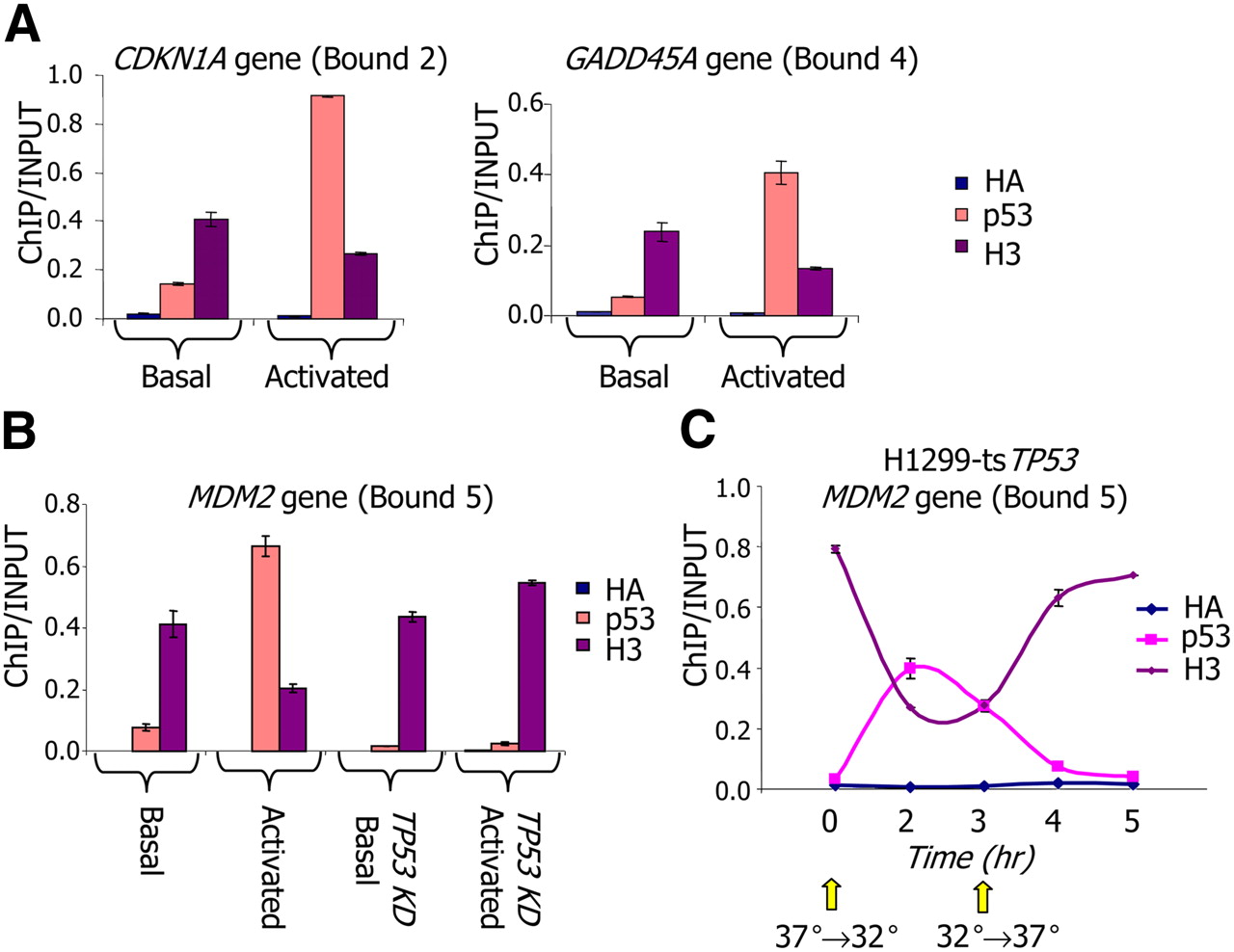
Nucleosome depletion from p53-bound sites is transient and rapidly reversible. (A) ChIP was performed with antibodies against p53, histone H3, or HA epitope tag (HA) as control, followed by quantification by qPCR of ChIP and input-sonicated genomic DNA for two bound sites, as defined in Figure 1A. Shown are the average and standard deviation (calculated from duplicate qPCR reactions) in nonstressed MCF7 cells (basal), and in MCF7 cells in which p53 was activated by Neocarzinostatin. Full details of selected sites are shown in Supplemental Table 1. (B) Similar to A but for a different p53-bound site, and where in addition to the cellular conditions measured in A, also shown are measurements in MCF7 cells with shRNA-mediated stable TP53 knockdown (TP53KD, Basal), and MCF7 cells with stable TP53 knockdown and treatment with Neocarzinostatin (TP53KD, Activated). (C) Similar to B, but measured throughout a time-course in H1299-tsTP53 cells harboring a temperature-sensitive TP53 mutant. At time zero, cultures were shifted from 37°C to the permissive temperature (32°C), resulting in p53 activation. After 3 h from the initial shift, cultures were shifted back to 37°C to turn off p53 transcriptional activity.


