


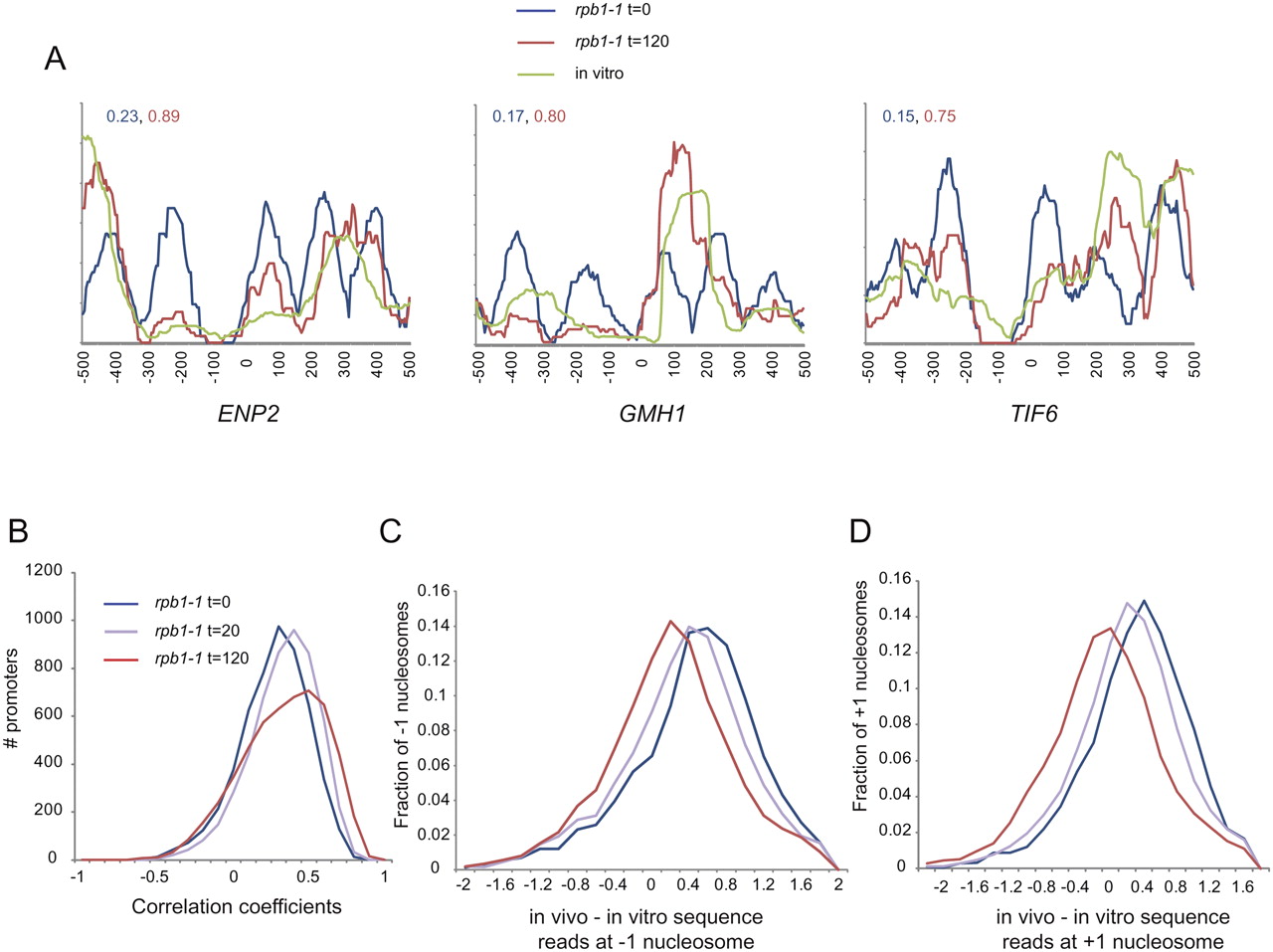
Nucleosomes relax toward in vitro preferred locations after Pol II loss. (A) Three examples of promoters where data from Pol II inactivation matches in vitro nucleosome assembly data better than data from before Pol II inactivation. Shown are extended read coverage along 1000 bp centered on TSS. Numbers shown in the inset are correlations between in vitro coverage and t = 0 (blue) and t = 120 (red) in vivo coverage. (B) Promoter chromatin architecture globally shifts toward in vitro preferences as polymerase is inactivated. Extended read coverage along the 1 kb centered on the TSS was extracted for all genes, and correlation coefficients were calculated to equivalent data for in vitro nucleosome reconstitution experiments (Kaplan et al. 2008). Histograms show a global shift of promoters toward the in vitro nucleosome pattern. (C) Normalized occupancy of −1 nucleosome better matches in vitro data after polymerase loss. For all −1 nucleosomes (called at t = 0 or at t = 120), the difference between in vivo normalized occupancy and in vitro normalized occupancy at the center of the in vivo nucleosome were calculated and presented as a histogram. (D) As in C, but for all +1 nucleosomes.



