


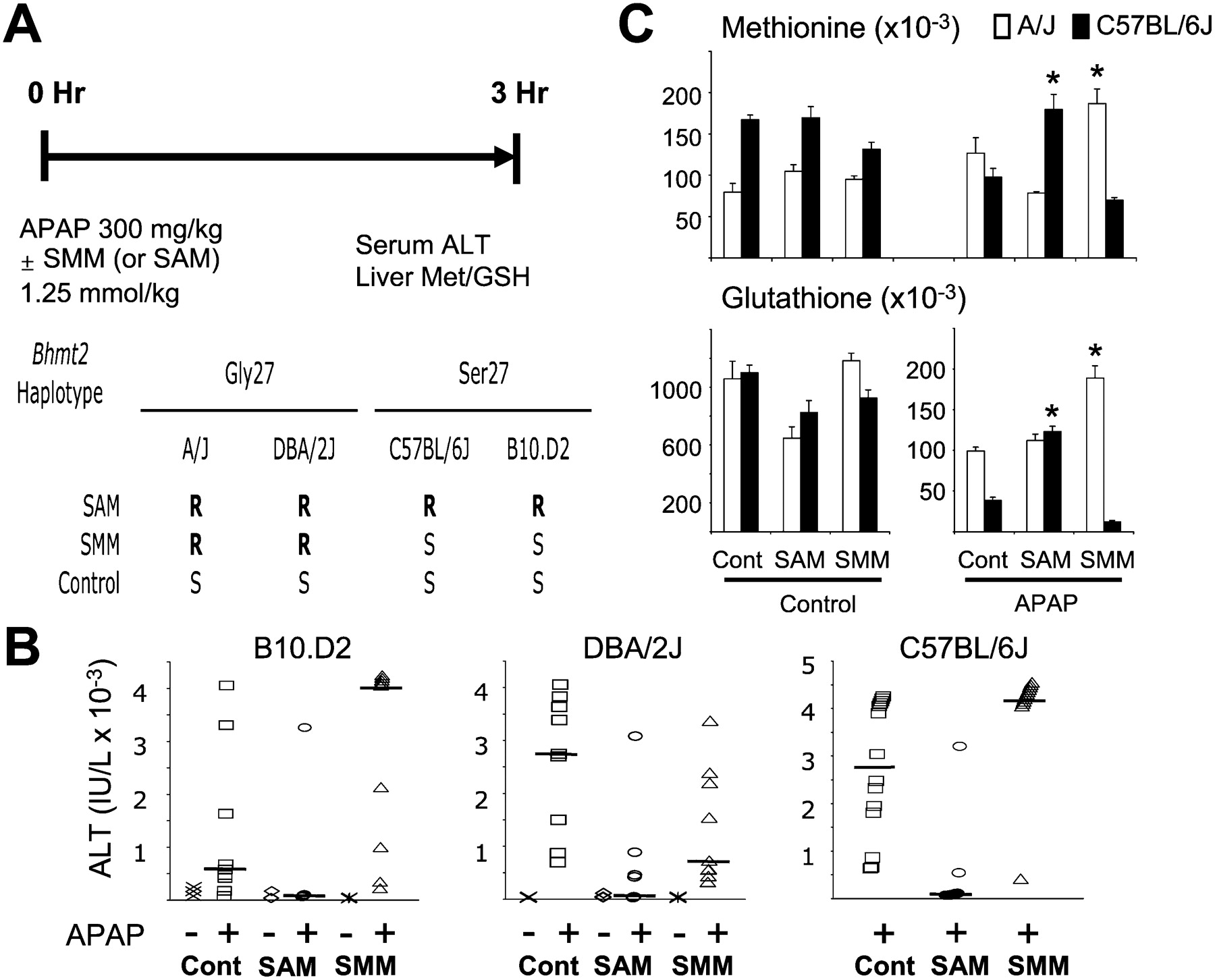
(A) Diagram of an experiment assessing the strain-specific effect of SMM or SAM coadministration on APAP-induced liver toxicity. Hepatic glutathione (GSH) and methionine levels and the serum ALT were measured 3 h after APAP administration to inbred strains. If BHMT2 activity affected sensitivity to APAP-induced liver injury, coadministration of a BHMT2-specific substrate (SMM) should have a protective effect in strains with active BHMT2 enzyme (Gly 27 allele), but not in strains with inactive (Ser 27 allele) enzyme. In contrast, SAM, which affects GSH biosynthesis at a step distal to BHMT2, should have a protective effect in all strains. Based upon the Bhmt2 allele, the R and S in the lower panel indicate whether SMM coadministration should have a protective (rescue, R) effect, or not have a beneficial (susceptible, S) effect on APAP-induced liver toxicity, respectively. (B) The serum ALT level was measured 3 h after treatment with vehicle, SAM, or SMM plus either vehicle or APAP. Nine or more mice were in each APAP-treated group. The horizontal line indicates the median value for each group, and P-values assessing whether SAM or SMM coadministration decreased the serum ALT levels relative to control were calculated. For DBA/2J mice, the P-values for the effect of SAM and SMM coadministration were 0.00058 and 0.0087, respectively. The effect of SAM and SMM coadministration in B10.D2 mice had P-values of 0.00029 and 0.9735, respectively. C57BL/6J mice had similar P-values (0.0000002 for SAM; 0.9985 for SMM). (C) C57BL/6J or A/J mice were treated with vehicle, SAM, or SMM plus either vehicle or APAP. Liver samples were obtained 3 h after dosing and the amount of GSH and methionine were determined by LC/MS/MS analysis. The data represent the average ± SE for N = three samples. An asterisk (*) indicates a P-value < 0.001 relative to the control-APAP treated mice by Student's t-test.



