


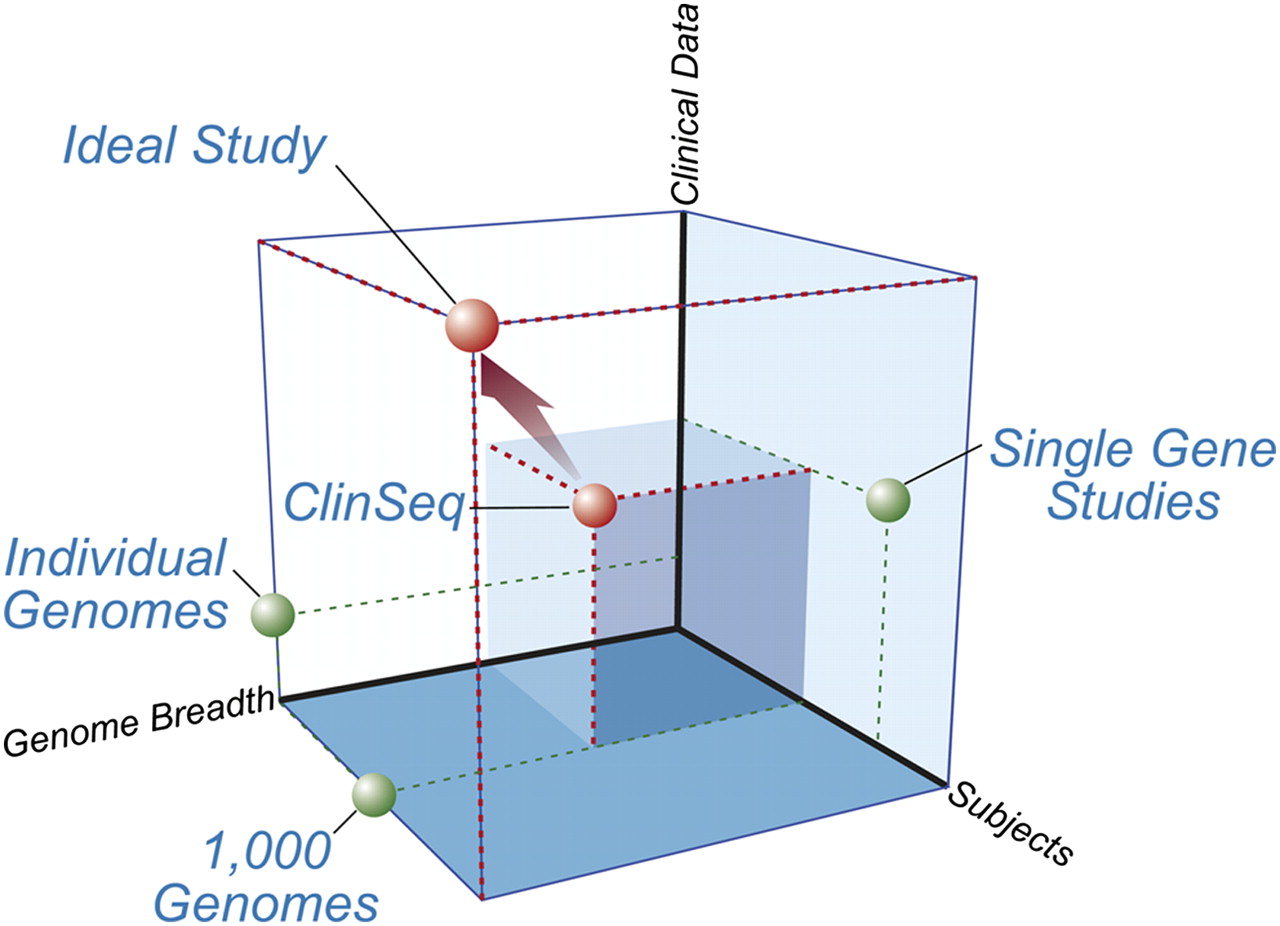
A spatial conceptualization of research studies in genomic medicine. There are three key “dimensions” to consider when applying genomics to clinical research: genome breadth (the fraction of the genome that is interrogated), number of subjects or participants, and the associated clinical data about those individuals (including its depth, breadth, and rigor). While the ideal study would acquire whole-genome sequences from large numbers of extensively phenotyped subjects, this is currently impractical. Single-gene studies can involve a few or numerous subjects and extensive clinical data, but by definition involve the examination of only a single gene and thus occupy one wall of this space. The individual genomes that have recently been sequenced (Levy et al. 2007; Bentley et al. 2008; Wang et al. 2008; Wheeler et al. 2008) provide nearly complete genome breadth, but with limited clinical data; further, their limited subject numbers place them on another wall of this space. The 1000 Genomes Project (http://www.1000genomes.org/) is providing large subject numbers and extensive genome breadth, but no clinical data—positioning it on the floor of this space. ClinSeq aims to reside in the center of this space, having attributes of substantial subject size (n = 1000 initially), moderate genome breadth (∼400 genes initially, with plans for expanding this breadth), and substantial clinical data.



