


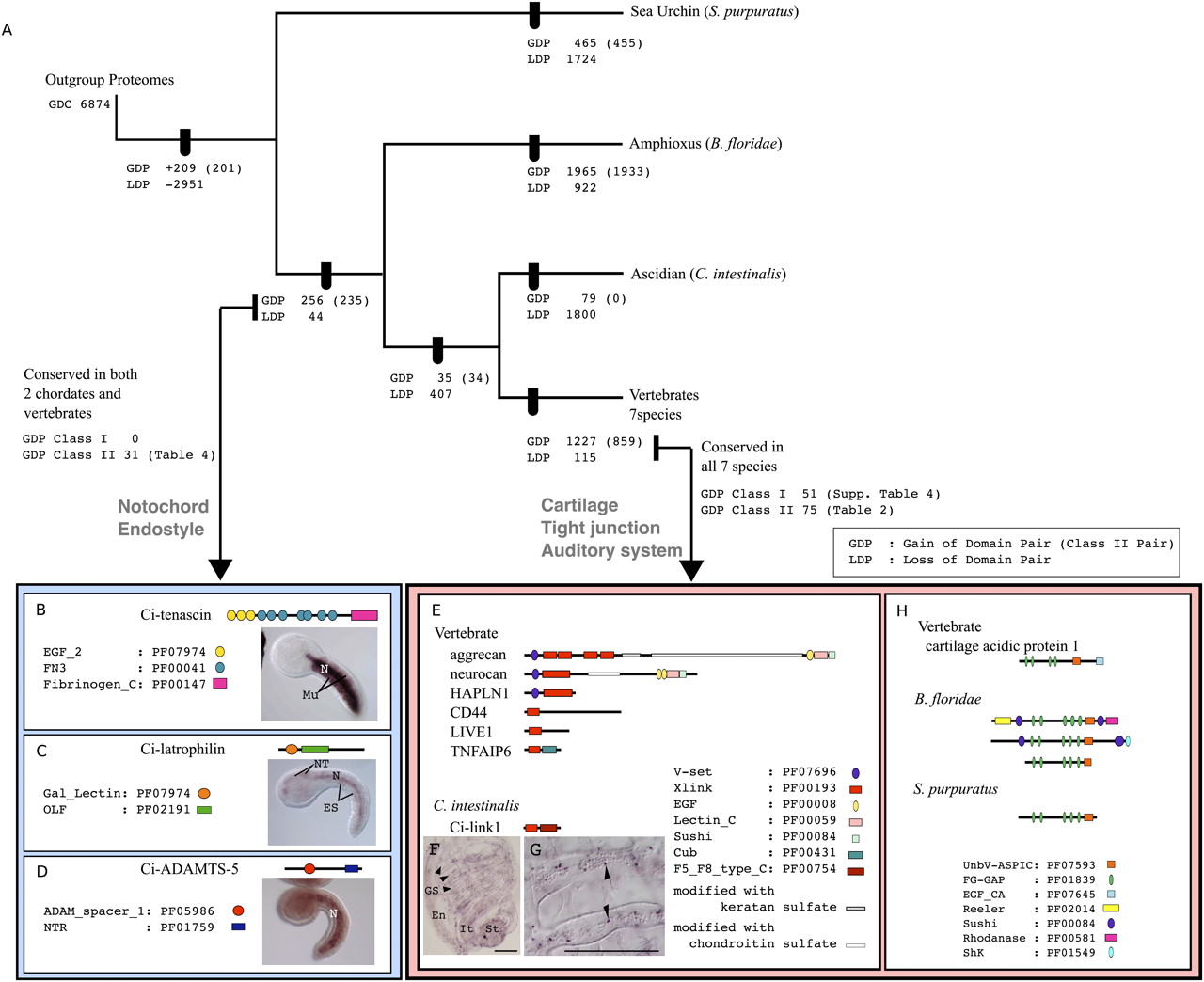
Domain shuffling during the evolution of deuterostomes. (A) Gain and loss of the domain pairs were mapped on the deuterostome phylogenetic tree constructed using molecular phylogenetic analyses of multiple gene sequences (Putnam et al. 2008). Numbers on each node present gains and loss of domain pairs after screening CI < 0.5 (see Methods for the definition of CI). Gains of Class II domain pairs are shown in brackets. (Arrows) Domain pairs acquired in the ancestral chordates, and those in ancestral vertebrates, that were examined in detail. Among 1227 pairs that were acquired in the ancestral vertebrates, 51 class I domain pairs and 75 class II domain pairs were conserved in seven vertebrate species examined. Some of these were involved in vertebrate-specific characters such as cartilage (E–H), tight junctions, and auditory systems (see text for details). Among 256 domain pairs unique to the chordates, 31 pairs were conserved in ascidian, amphioxus, and more than one species of vertebrates. Some of them were involved in chordate-specific characters such as the notochord (B–D) and endostyle (see text for details). (B–D) Tenascin, latrophilin, and ADAMTS-5, which were created by domain shuffling in ancestral chordates, are expressed in the notochords of ascidian embryos. Symbols are indicated with the domain ID and Pfam accession numbers (Finn et al. 2006). (B) Ci-tenascin is expressed in the ascidian notochord (N) and muscle cells (Mu). (C) Ci-latrophilin expression was detected in the notochord, neural tube (NT), and endodermal strand (ES) of ascidian larvae. (D) Expression of Ci-ADAMTS-5 was restricted to the ascidian notochord. (E) Domain structures of the proteins that include an Xlink domain. (F,G) Expression of Ci-link1 was observed in some of the blood cells from an ascidian juvenile. (Arrowheads) Some of the Ci-link1-positive cells. Scale bars, 50 μm. (En) Endostyle, (GS) gill slits, (St) stomach, (It) intestine. (H) Domain structures of cartilage acidic protein and proteins containing an ASPIC-and-UnbV domain encoded by amphioxus gene models.



