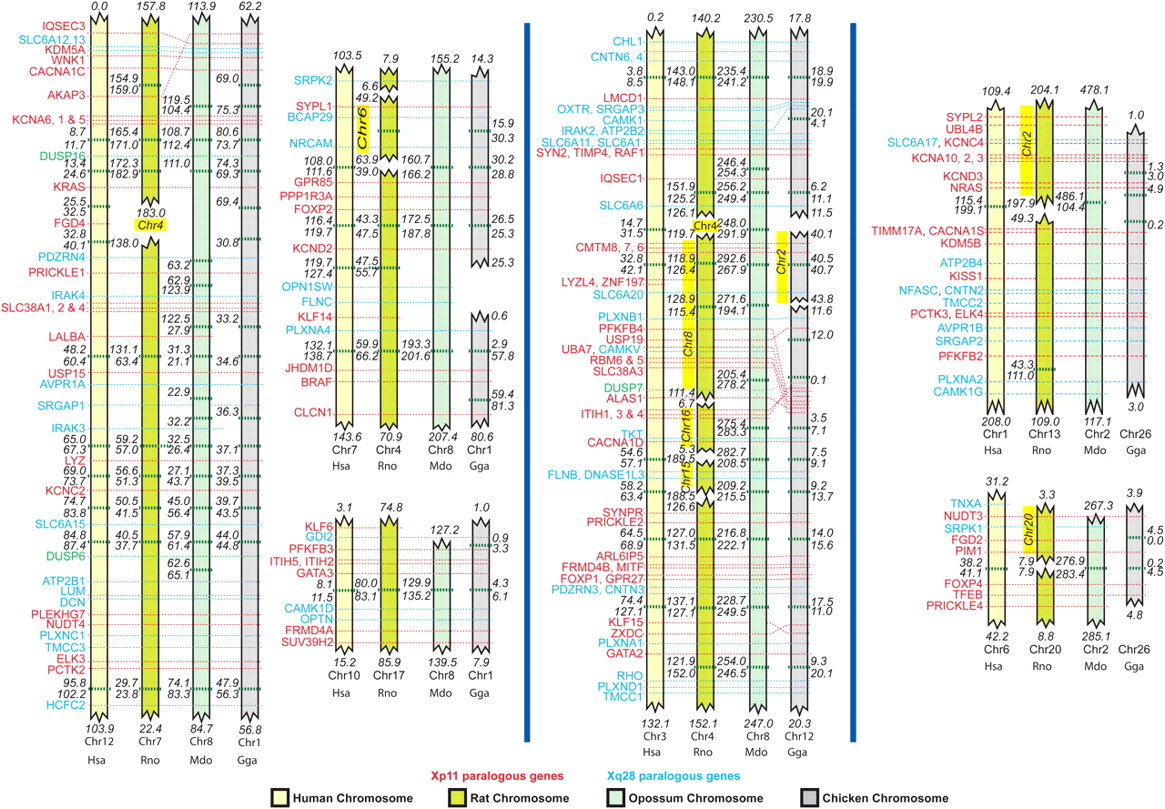
Conservation of Xp11 and Xq28 paralogs and their genomic contexts in different species. Schematic representation of the location of Xp11 paralogs (red) and Xq28 paralogs (blue), including 1 Mb of genomic context surrounding each, on chicken (Gga, gray) chromosomes 1, 12, and 26. Conservation of the positions of these genes is indicated by the red and blue dotted lines across human (Hsa, yellow), rat (Rno, yellow-green), and opossum (Mdo, blue-green) chromosomes. Chromosome (Chr) numbers are indicated either below or at the side of each conserved segment, and the start and end points of the conserved sections along the chromosomes are indicated in megabases from the terminus of the short arm. Small intervals between the conserved blocks on a single chromosome are indicated by green horizontal dotted lines, and the start and end points of the intervals are also indicated in megabases from the tip of the short arm. Members of the DUSP gene family are found in both Xp11 and Xq28, and their paralogs are indicated in green.