


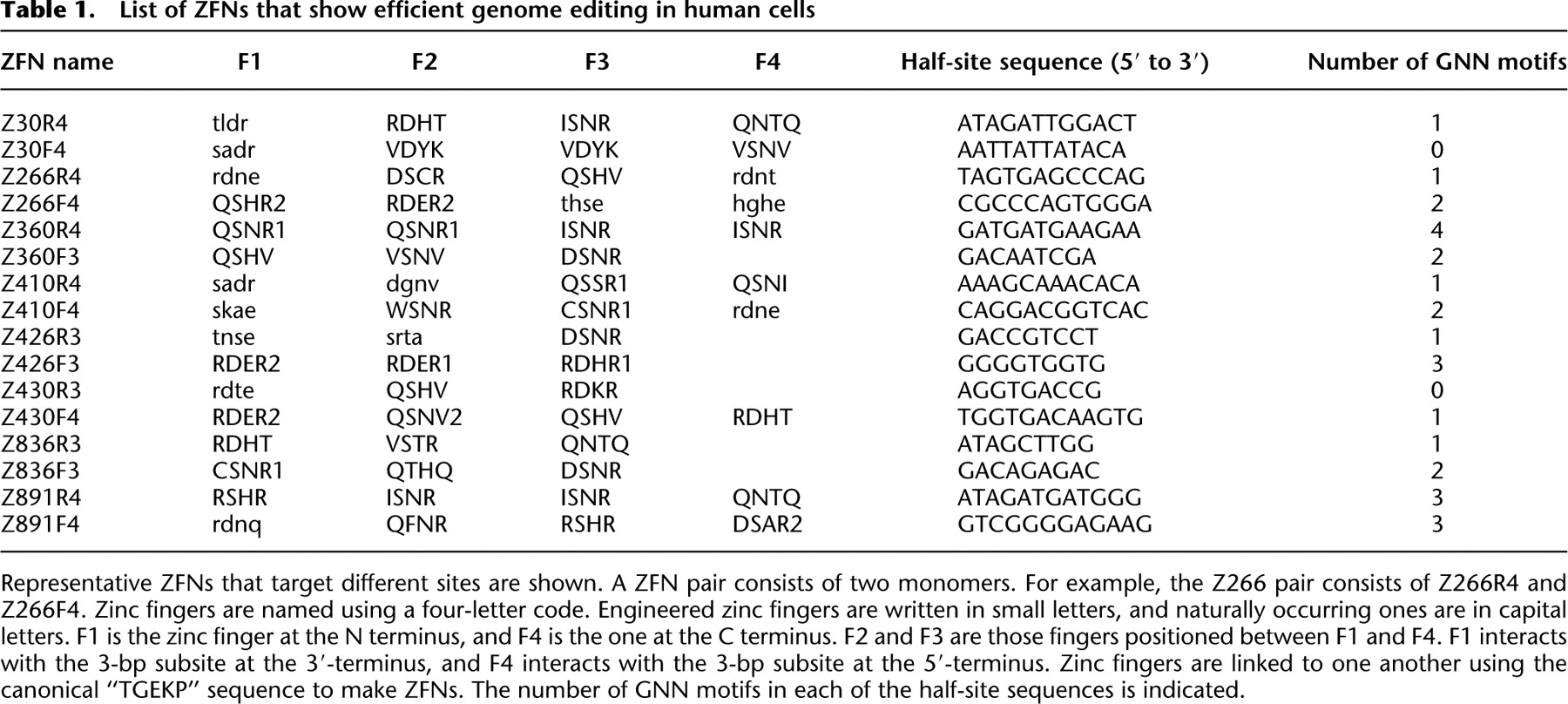
List of ZFNs that show efficient genome editing in human cells
Click on table to view larger version.
-
Representative ZFNs that target different sites are shown. A ZFN pair consists of two monomers. For example, the Z266 pair consists of Z266R4 and Z266F4. Zinc fingers are named using a four-letter code. Engineered zinc fingers are written in small letters, and naturally occurring ones are in capital letters. F1 is the zinc finger at the N terminus, and F4 is the one at the C terminus. F2 and F3 are those fingers positioned between F1 and F4. F1 interacts with the 3-bp subsite at the 3′-terminus, and F4 interacts with the 3-bp subsite at the 5′-terminus. Zinc fingers are linked to one another using the canonical “TGEKP” sequence to make ZFNs. The number of GNN motifs in each of the half-site sequences is indicated.


