


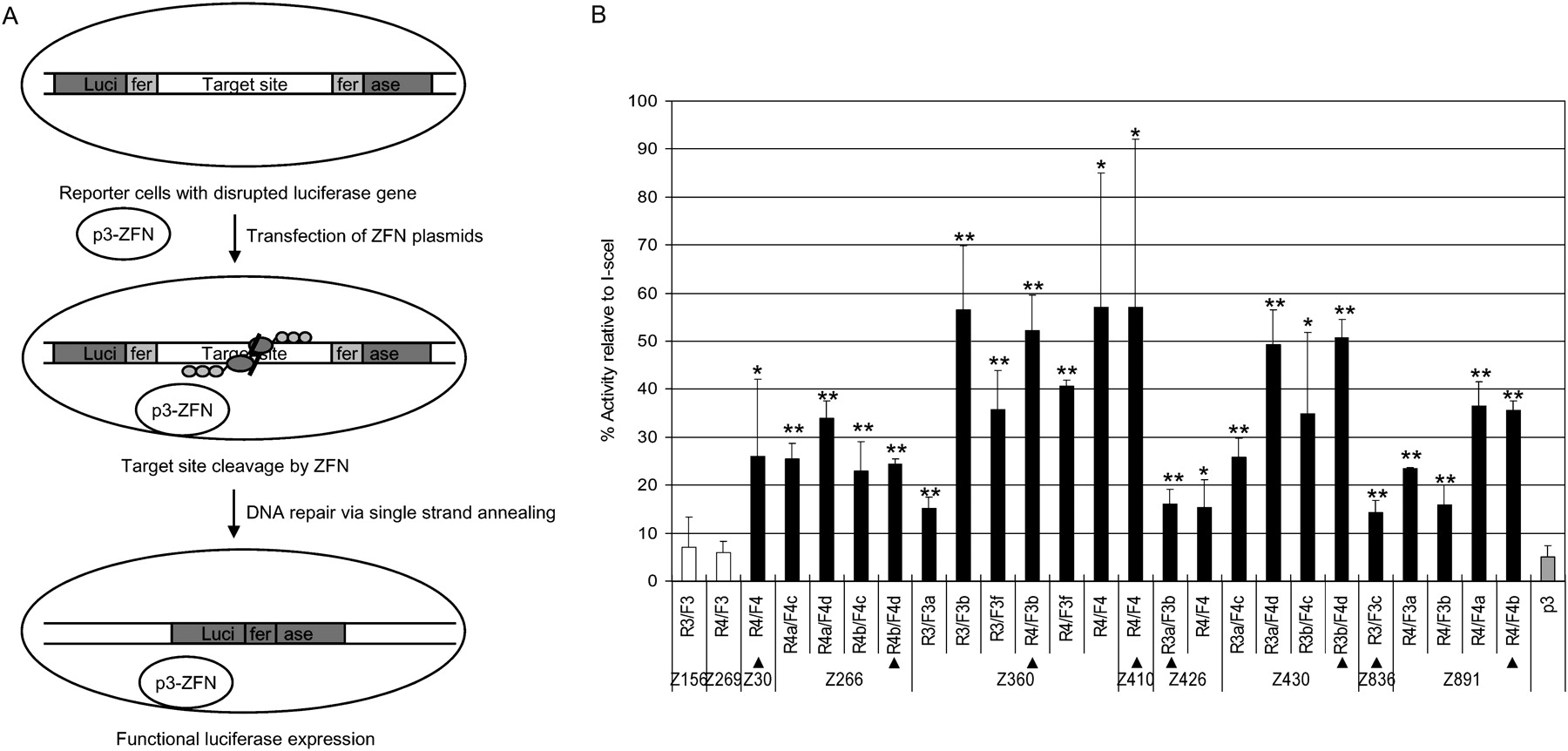
Assessment of ZFN activities using a cell-based single-strand annealing (SSA) system. (A) Schematic overview of a single-strand annealing system. ZFN expression plasmids are transfected into HEK293 cells whose genome contains an inactive, partially duplicated, and disrupted luciferase gene. If ZFNs cleave target sites in cells, DNA is efficiently repaired by the SSA mechanism, and the functional luciferase gene is restored. (B) Luciferase activities of cells in which various ZFNs are expressed. p3 (gray bar) is the empty plasmid, which was used as a negative control. The target sequence contains the recognition site of I-SceI, which was used as a positive control. The activity of each ZFN pair is reported as the percentage relative to the I-SceI control. ZFN pairs and their constituent monomers are indicated. The ZFN pairs used in further studies are marked with triangles. Means and standard deviations (error bars) from at least three independent experiments are shown. Black and white bars indicate active and inactive ZFNs, respectively. P-values were calculated with the Student's t-test; (*) P < 0.01; (**) P < 0.001 (p3 control vs. ZFN).


