


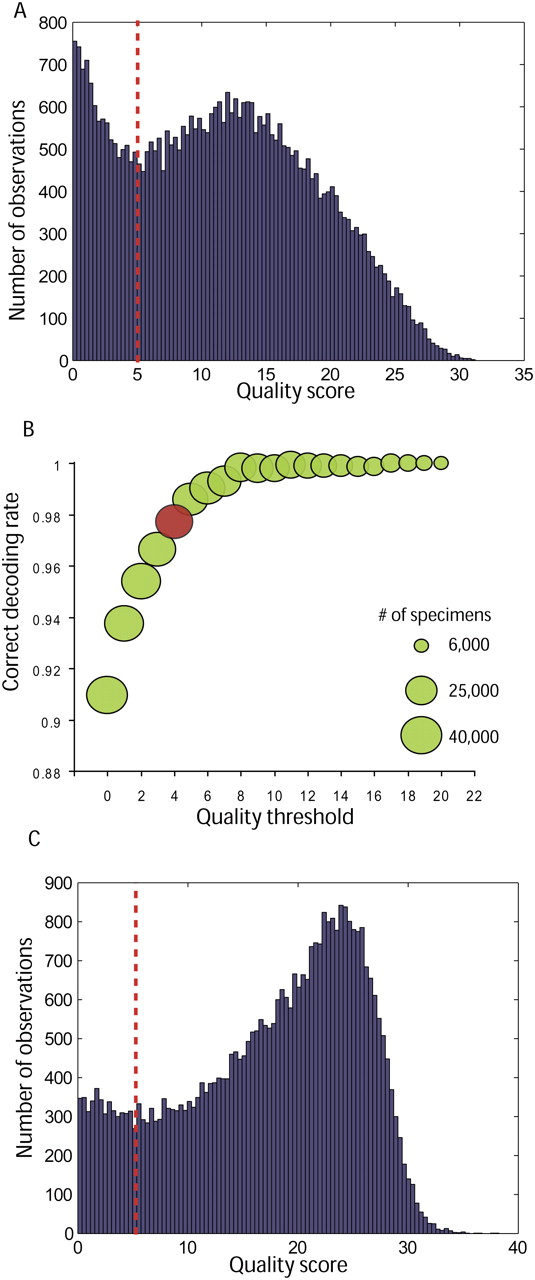
Performance of the minimal discrepancy decoder. (A, red line) The distribution of quality scores for the Arabidopsis library is bimodal with transition around a quality score of 5. We speculate that this corresponds to two decoding regimes—noisy on the left and error-free on the right. (B) Analyzing the correlation between filtering above different quality scores and the correct decoding rate. The size of the bubbles corresponds to the number of specimens passing the threshold. The increase in the correct decoding rate with the threshold of the quality validates the predictive value of the quality scores. (Red bubble) The strong drop in the correct decoding rates below a quality score of 5 confirms our speculations about the two decoding conditions. (C) The quality score distribution of the human library. The noisy area, left of a quality score of 5, contains fewer specimens than observed in the Arabidopsis library. The shift of the distribution to the right suggests better decoding performance presumably owing to higher sequencing depth. After filtering specimens with a quality score above 5, the correct decoding rate was estimated to be 98.2% for 36,000 specimens and indicates the robustness of the quality score. Decoding all specimens regardless of the quality score revealed a correct decoding rate of 97.3%.


