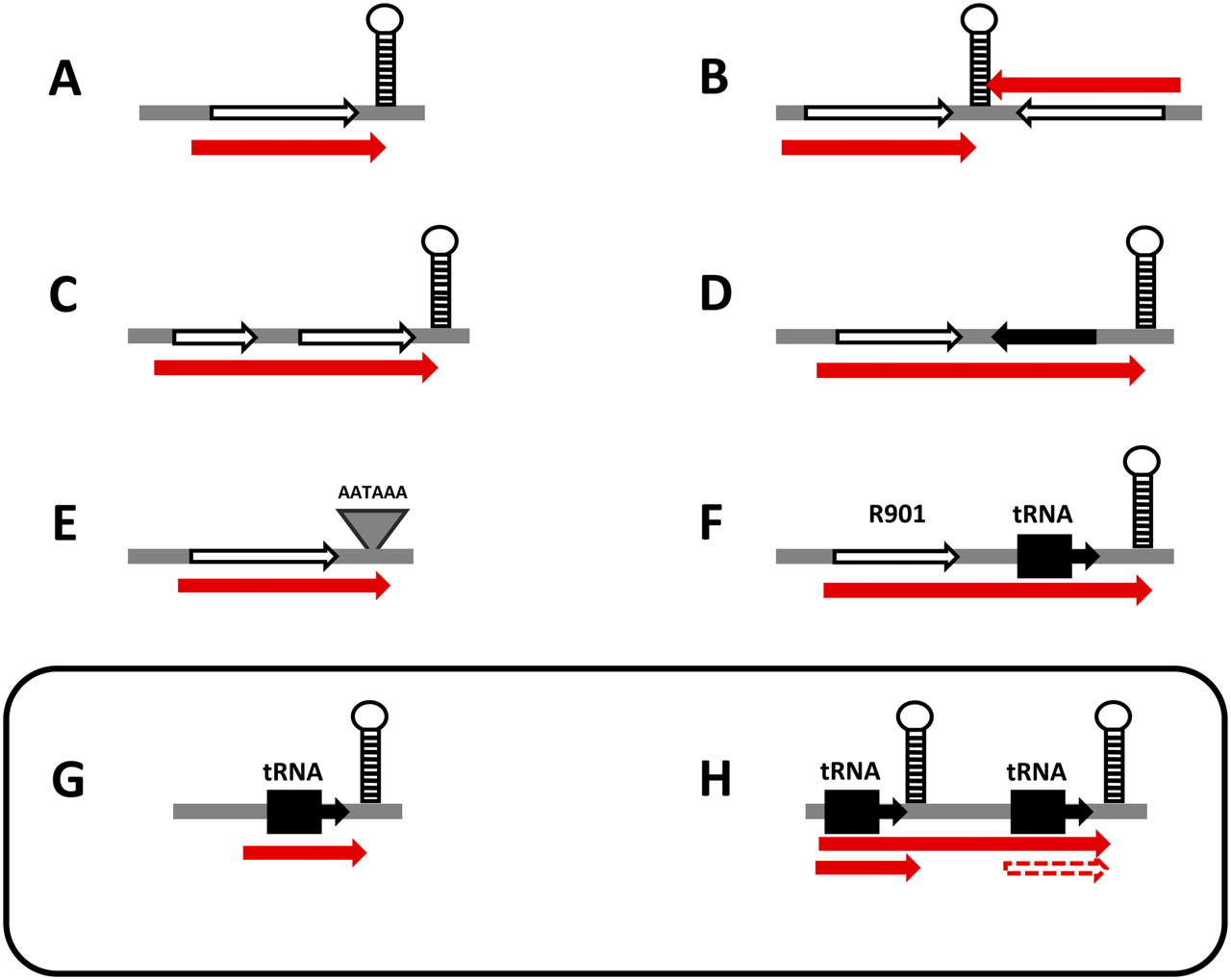
Experimentally validated Mimivirus polyadenylated transcript structures. Palindromic sequences are represented by hairpins; ORFs are indicated by open arrows; and transcripts by red arrows. (A) Single ORF followed by a palindromic polyadenylation signal; ∼70% of transcripts might fall in this category; 27 have been experimentally validated through a gene-by-gene analysis. (B) Convergent ORFs sharing the same palindromic polyadenylation signal; four such pairs have been validated (R257/ L258, R453/ L454, R497/L498, R528/L529). (C) “Polycistronic” transcripts, wherein polyadenylation occurs within the first palindromic signal encountered. Two such transcripts have been validated (L416-417, R882-883). (D) “Pseudo-polycistronic” messenger, wherein the 3′-UTR encompasses a neighboring ORF in the reverse orientation. Two such cases have been validated (L356-R355, L778-R777). (E) Infrequent cases of polyadenylation occurring within a low-scoring palindrome (e.g., L164) or following an AATAAA motif (e.g., R502, L532, polycistronic R463-465). (F) A unique case of a polyadenylated bi-cistronic transcript mixing the R901 ORF and a downstream neighboring tRNALeu. (G) Polyadenylated transcripts of individual tRNA genes (tRNATrp, tRNAHis). (H) Polyadenylated transcripts encompassing two adjacent tRNA genes (tRNAHis + tRNACys) coexisting with a single gene polyadenylated transcript (tRNAHis).