


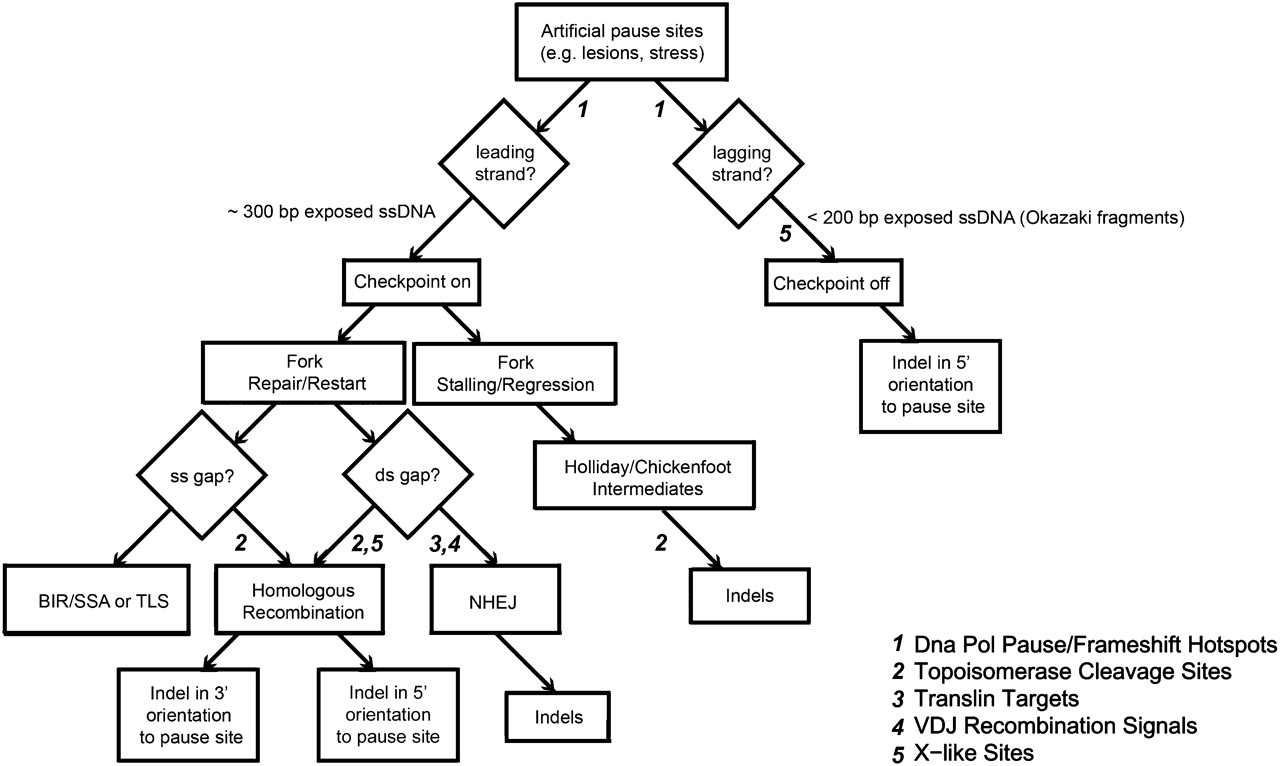
Replication and recombination pathways proposed to contribute to insertion and deletion mutagenesis (numbers correspond to motif classes indicating involvement as evidenced by results; for details, see Discussion). DNA replication can pause when encountering natural pause sites or artificially due to lesions, stress, and/or specific sequence cues. Depending on the strand, single-stranded DNA (ssDNA) is exposed and replication checkpoint can be triggered or bypassed. Cells respond to replication pausing by repair or restart of the forks, depending on the type of lesion created at the paused site. Double-strand gaps are repaired via homologous recombination or nonhomologous end joining (NHEJ), whereas single-stranded gaps can be repaired via homologous recombination, break-induced replication (BIR) followed by single-strand annealing (SSA), or translesion synthesis (TLS). Our results confirm that NHEJ repair of double-stranded gaps and homologous recombination (of double- and/or single-stranded gaps) could contribute to indel mutagenesis. Stalling of the fork can result in regression and Holliday junction/chickenfoot intermediates, which can be repaired and thus cause indel formation. Checkpoint bypass can also lead to indels.



