


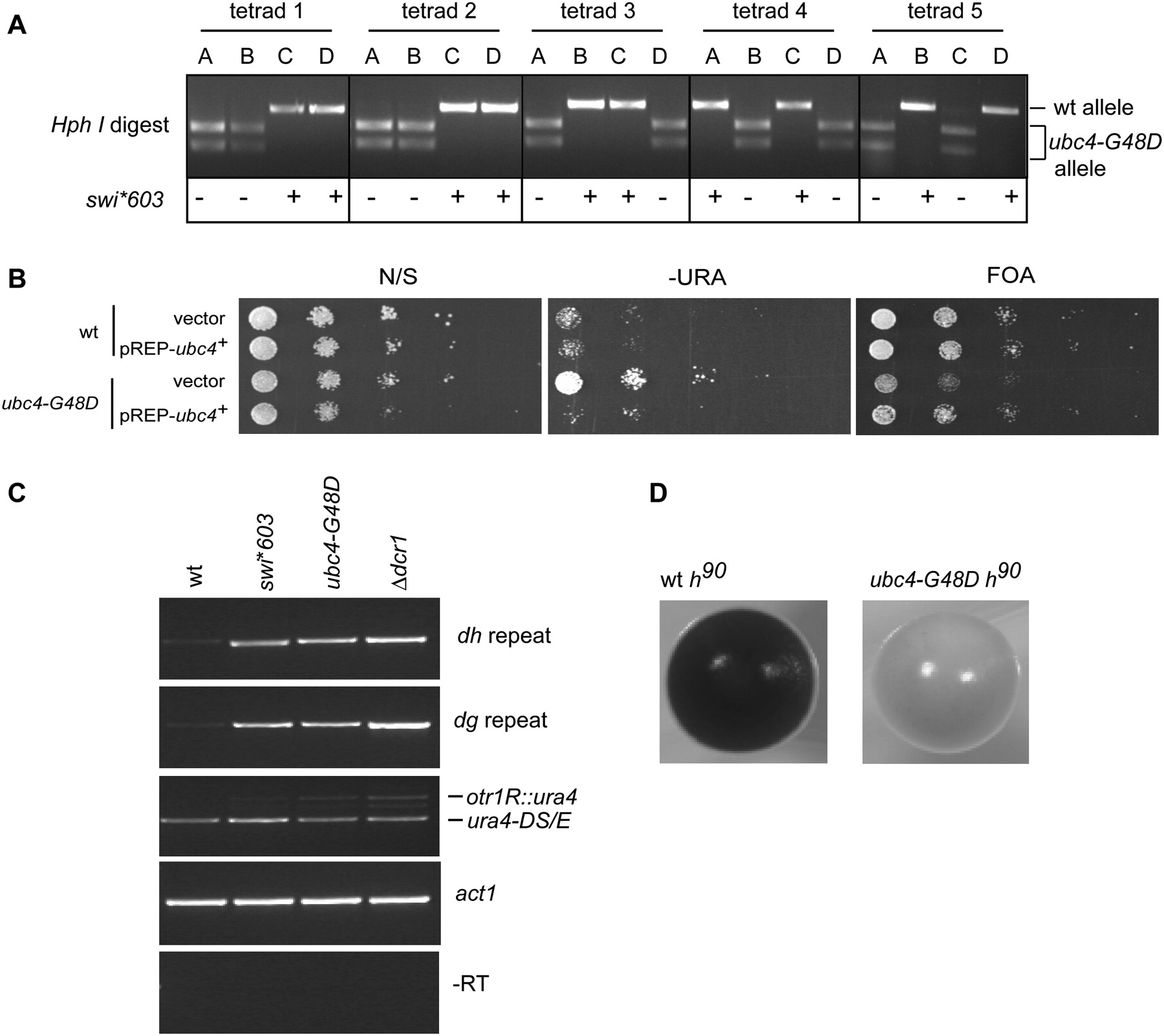
Verification that the ubc4-G48D mutation is responsible for swi*603 strain phenotypes. (A) The ubc4-G48D mutant allele segregates 100% with the swi*603 centromeric otr1R∷ura4+ reporter gene loss of silencing phenotype. The ubc4-G48D allele is cut with HphI to yield two bands, while ubc4+ is not digested. Pericentromeric reporter gene otr1R∷ura4+ silencing is assayed by growth on plates lacking uracil (−URA). (−) Loss of ura4+ reporter gene silencing/growth on −URA plates/swi*603 allele; (+) silencing ura4+ reporter gene/no growth on −URA plates/wt. (B) The ubc4+ gene can complement the heterochromatic silencing defect in ubc4-G48D cells. Wild-type (wt) or ubc4-G48D cells were transformed with an empty G418-based plasmid or one expressing ubc4+ under the control of an inducible medium-strength nmt1 promoter. Serial dilution plating assays were performed (−thiamine) to measure the expression of the pericentromeric otr1R∷ura4+ reporter gene. Cells were serially diluted 1/10, starting with 1 × 10⁴, and spotted onto nonselective plates (N/S), plates lacking uracil (−URA), and counter-selective plates containing 5-fluoro-orotic acid (FOA). (C) The ubc4-G48D allele when introduced into wt DG21 causes accumulation of centromeric transcripts and the pericentromeric otr1R∷ura4+ reporter gene. (D) The iodine staining phenotypes of homothallic (h90) wt SGP17 and a regenerated ubc4-G48D strain show that the ubc4-G48D allele affects mating-type switching.



