


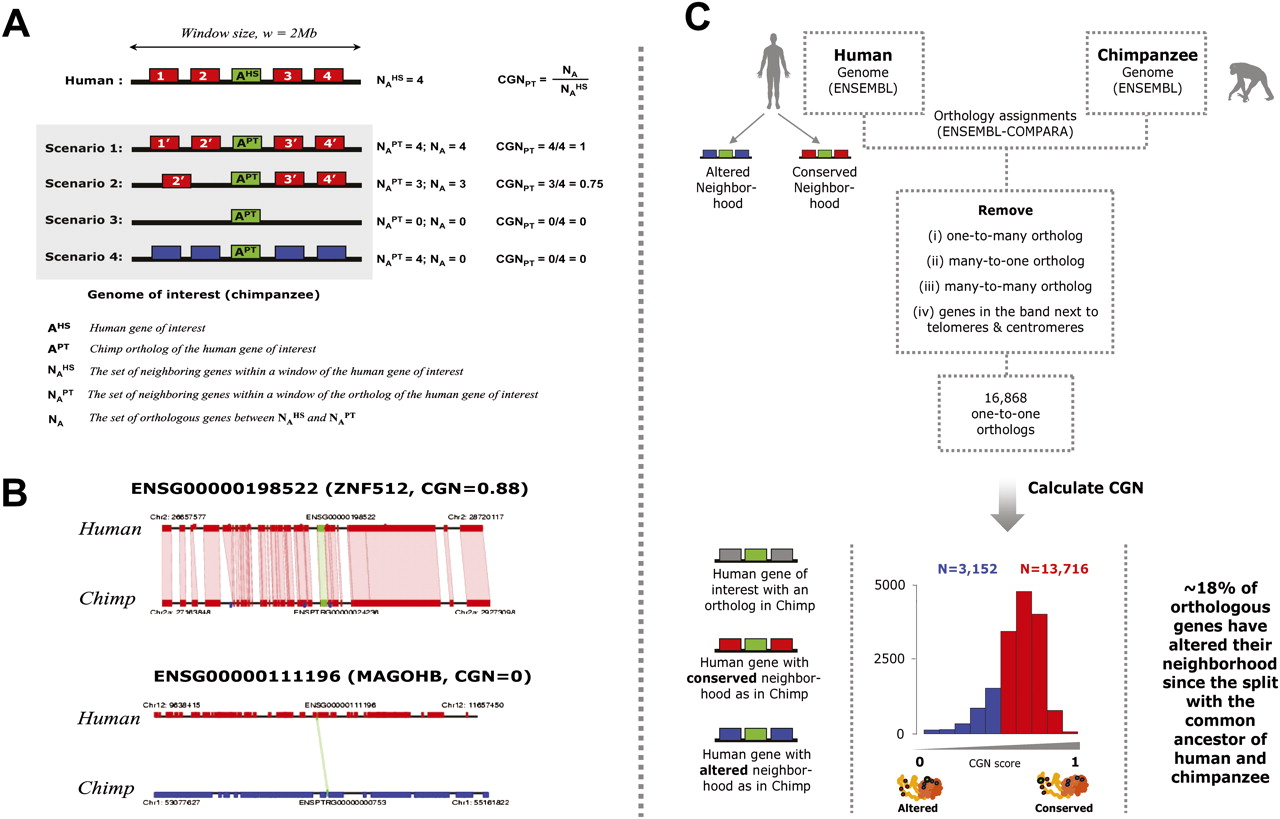
(A) Definition of conservation of genomic neighborhood (CGN). The gene of interest is shown in green and the neighbors of human genes are shown in red, labeled 1–4. The different evolutionary scenarios, resulting in a CGN score between 0 and 1, while comparing the neighborhood of orthologous chimpanzee and human genes are illustrated. Orthologs of the neighbors of the human gene in chimpanzee are shown in red and labeled 1′–4′. Neighbors of the chimpanzee gene that are not neighbors of the human ortholog are shown in blue. Because of the way in which the CGN score is calculated, the identification of genes with low CGN would include both the set of genes that have changed their neighborhood either in the human lineage or in the chimpanzee lineage after the split from their common ancestor. (B) An example of a gene with highly conserved genomic neighborhood (CGN = 0.88, ZNF512) and completely altered genomic neighborhood (CGN = 0, MAGOHB). (C) A CGN score was calculated for every one-to-one orthologous gene in human using chimpanzee as a reference genome and a histogram of the distribution is shown below. Genes with conserved neighborhood (CGN > 0.5) are shown in red while those with altered neighborhood (CGN ≤ 0.5) are shown in blue.



