


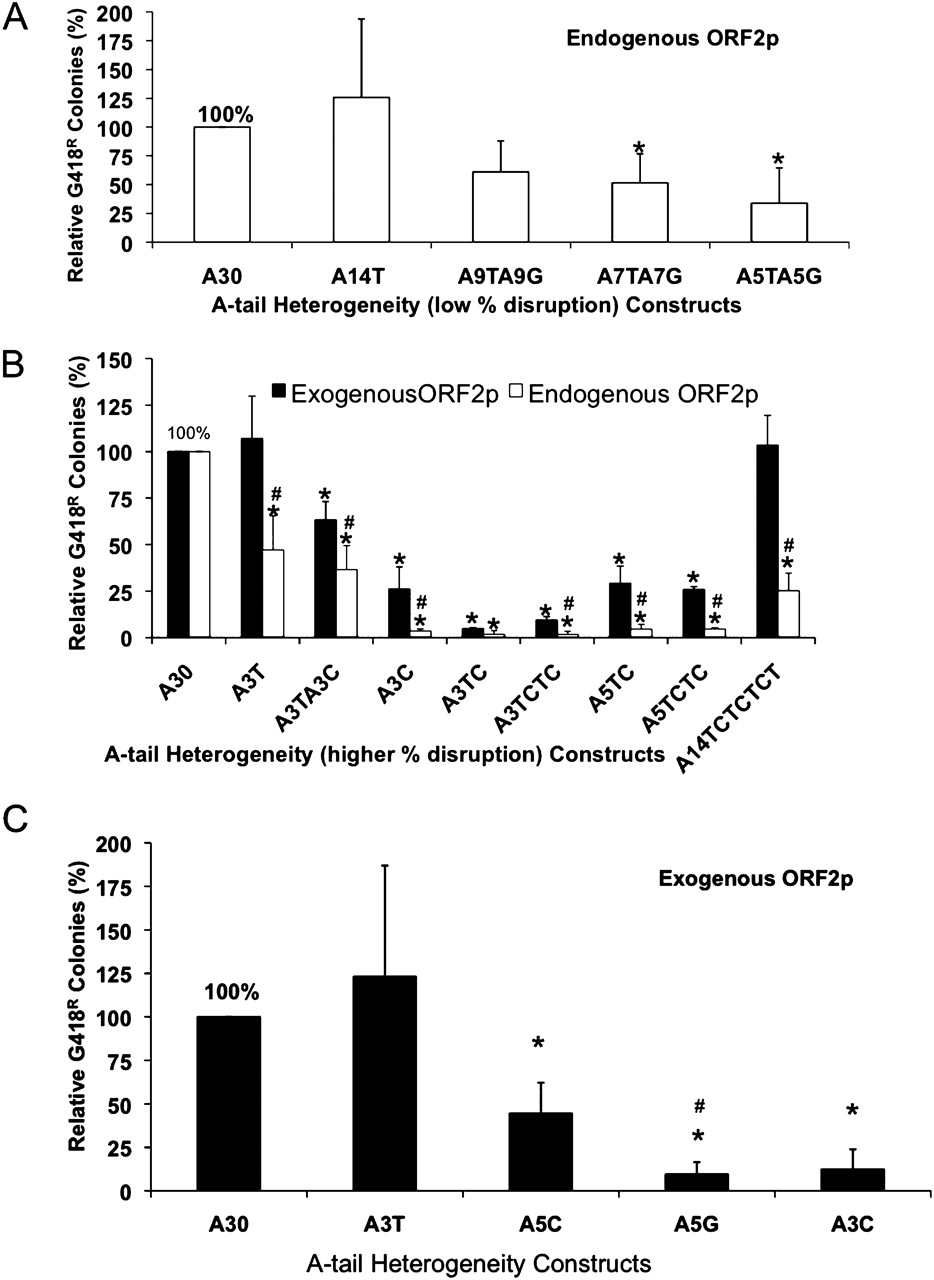
Increased A-tail heterogeneity reduces Alu retrotransposition capability. HeLa cells were transiently transfected with the corresponding Alu-tagged constructs driven by endogenously or exogenously supplied ORF2p. The relative activity of Alu elements with slightly disrupted A-tails (A) or extremely disrupted A-tails (B) is shown. The Alu with 30 homogenous As (A30) was arbitrarily selected as 100%; the asterisk (*) indicates a significant difference from A30, P < 0.05 (Students paired t-test). (C) The evaluation of how specific base disruptions in the A-tail affect retrotransposition rate (T >> C > G) under exogenous conditions of ORF2p is shown. (*) Asterisk indicates a significant difference between A5C, A5G, and A3C relative to A3T, P < 0.05, P < 0.01, and P < 0.01, respectively (Students paired t-test); # indicates a significant difference between A5C and A5G, P < 0.01 (Students paired t-test).



