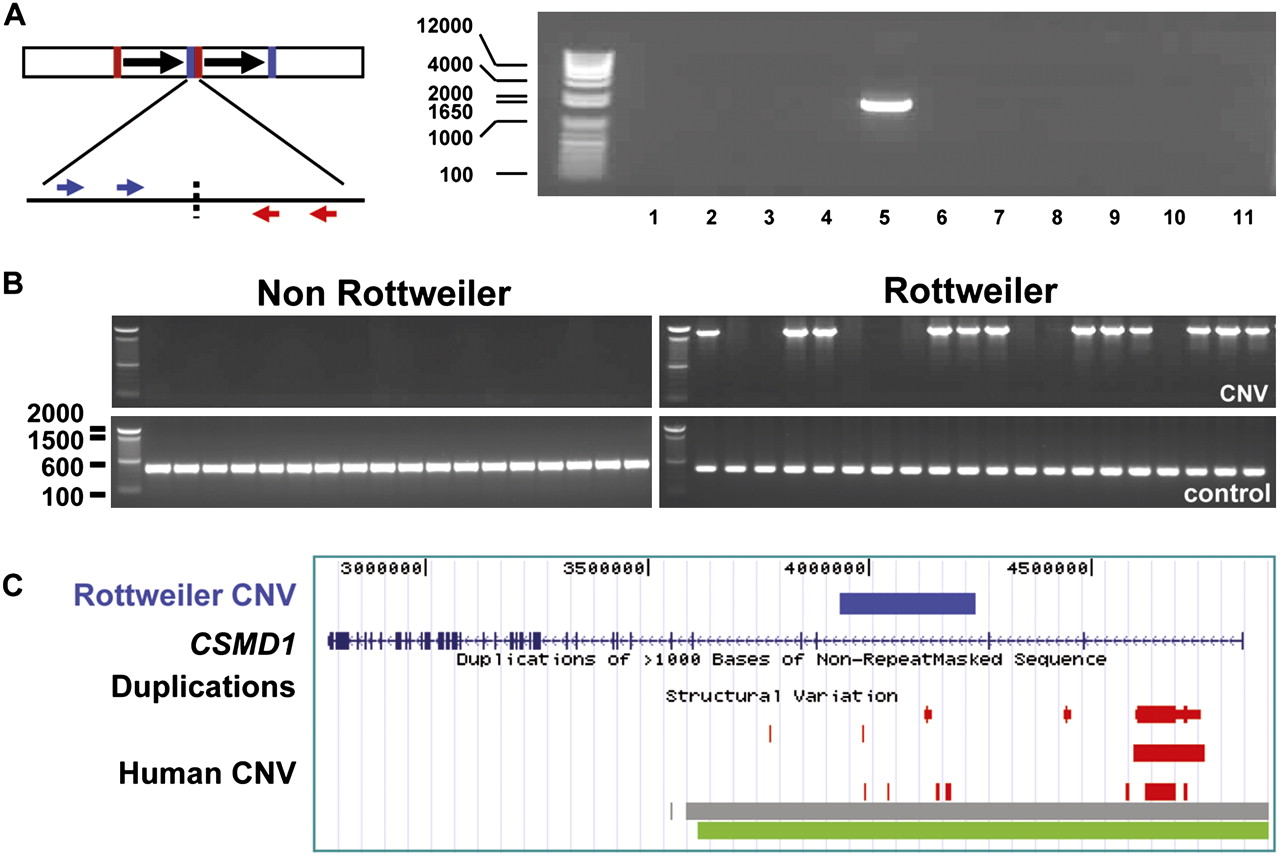
Molecular definition of a Rottweiler-specific CNV. A 273-kb CNV on chr 16 was detected by aCGH only in the Rottweiler of the discovery set. (A) (Left) A schematic of the PCR assay used for validation. Each forward/reverse primer combination was used to test for tandem duplication of the aCGH CNV. (Right) The two internal primers generated a <2-kb fragment in the original Rottweiler, but not the nine other dogs. The breakpoint was determined to single nucleotide resolution by sequencing this amplicon. This confirms a head to tail orientation of the duplication. All samples are from unrelated members of pedigreed dogs (left to right): no template control, Boxer, Bulldog, Collie, Rottweiler 1, Golden Retriever, German Shorthair, Shetland Sheepdog, Basset Hound, Akita 1, Akita 2. (B) A second panel of 20 Rottweilers and 20 non-Rottweiler dogs shows the CNV is common in Rottweilers, but absent in the other breeds tested (see Methods). (C) The entire dog CNV unambiguously lies within intron 3 of CSMD1. Human CSMD1 is shown with the dog CNV mapped (blue bar) and compared to previously reported human CNVs (losses in red, gain in green, gain or loss in gray). The CNV spans several conserved elements, including four with PhastCons LOD values ≥98 (compare to the two flanking exons, with LOD = 93 and 31).