


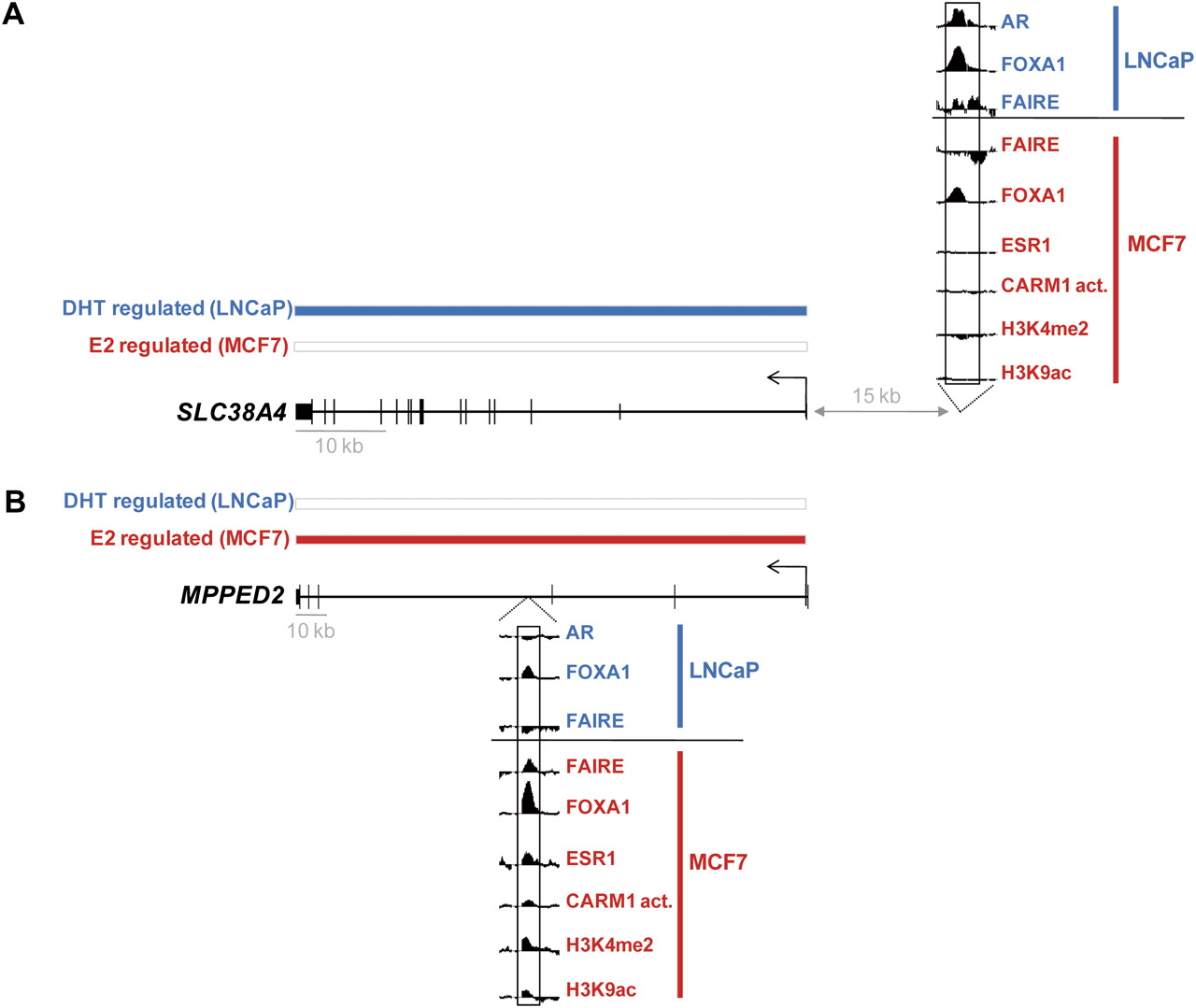
Correlation between selective activity of common FOXA1 binding sites and cell-type-specific gene regulation. Examples of genes associated with FOXA1 binding sites common to MCF7 and LNCaP cells, but regulated in a cell-type-specific manner. Individual probe level signal for FAIRE-chip and ChIP-chip of the indicated factors or histone marks within the FOXA1 binding sites is shown. Transcriptional regulation by dihydrotestosterone (DHT) in LNCaP cells (Wang et al. 2007) or by estradiol (E2) in MCF7 cells (Carroll et al. 2006) was determined using a t-test (P < 5 × 10⁻³) and is indicated by blue and red bars, respectively. (A) Example of a gene regulated by DHT in LNCaP, but not by E2 in MCF7. (B) Example of a gene regulated by E2 in MCF7, but not by DHT in LNCaP. Note that shared FOXA1 binding sites with selective activities are often associated with cell-type-specific ones in the vicinity of target genes. This is consistent with the clustering of transcription factor recruitment regions nearby regulated genes (Chan and Song 2008; Krum et al. 2008).



