


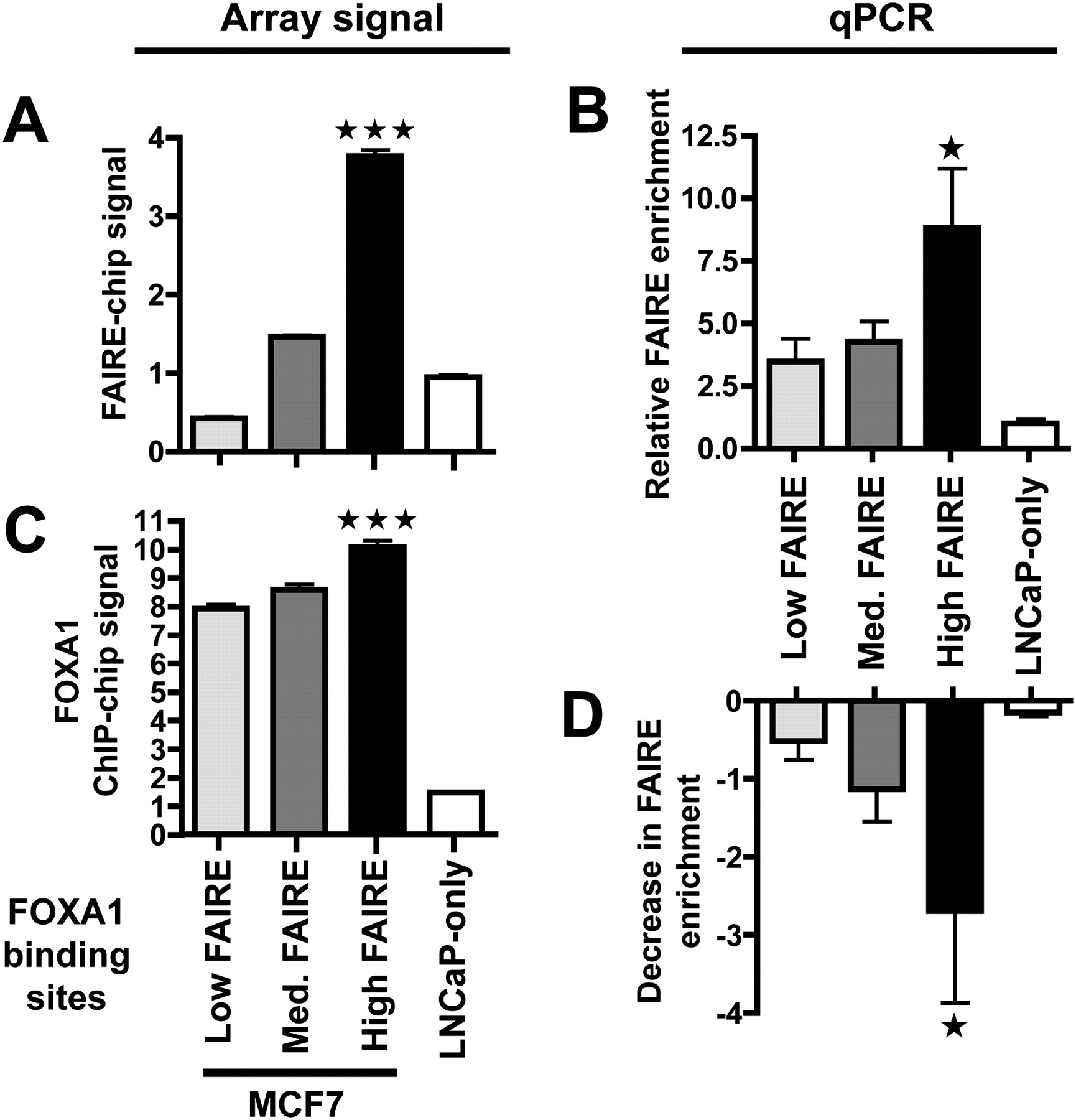
FOXA1 is required but not sufficient for high FAIRE enrichment at bound regulatory elements. (A) FOXA1 binding sites were divided into tertiles and the average FAIRE-chip signal (based on MAT scores, see Methods) for each subset of sites (low, medium, and high FAIRE) was calculated. Each subset was comprised of 645 sites. FAIRE-chip enrichments at FOXA1 LNCaP-specific sites were also analyzed. Data represent mean ± SEM of signals derived from MAT analysis of FAIRE-chip data. (B) FAIRE-qPCR experiments were performed in MCF7 cells to monitor FAIRE enrichment at the indicated categories of FOXA1 recruitment regions (at least 8 different sites were analyzed for each subset). Relative enrichment compared to negative control regions is shown. Data are mean ± SD from three independent experiments. (C) Signals from FOXA1 ChIP-chip in MCF7 cells within FOXA1 binding sites with low, medium or high FAIRE-chip enrichments. LNCaP-specific sites were also analyzed. Data represent means ± SEM of signals derived from MAT analysis of the FOXA1 ChIP-chip data from Lupien et al. (2008). (D) FAIRE-qPCR experiments performed as in B. Decrease in FAIRE enrichments triggered by FOXA1 silencing is shown. Data are mean ± SD from three independent experiments. *** and * Indicate a statistically significant difference between FOXA1 recruitment sites with high and low FAIRE enrichments (P < 0.001 and P < 0.05, respectively).



