


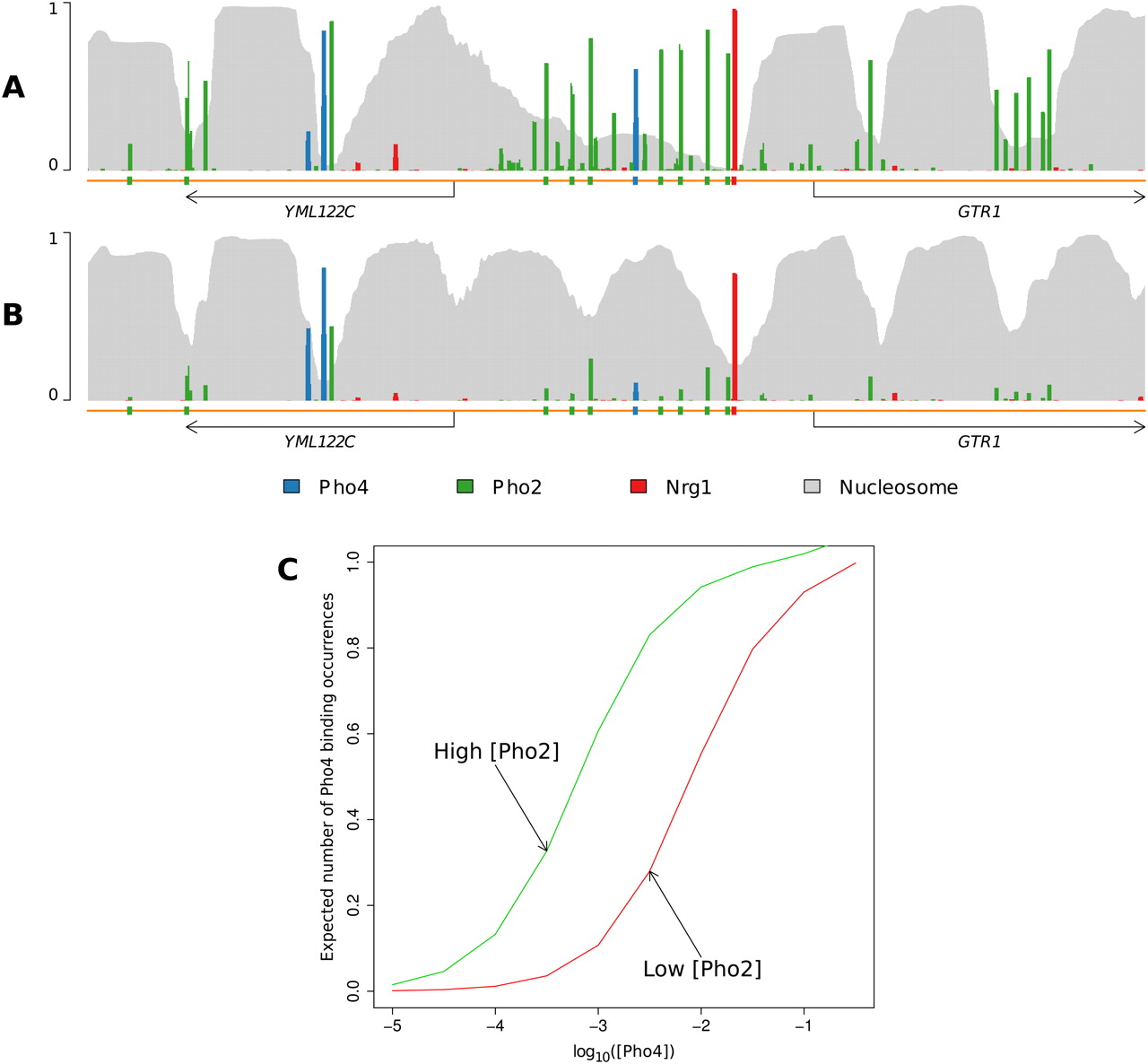
Cooperative binding emerges implicitly from explicit competition between DBFs. Revisiting the GTR1 promoter, cooperativity among Pho4 and Pho2 can be observed via mutual competition with nucleosomes, particularly the nucleosome positioned atop the annotated Pho4 site and Pho2 sites adjacent to the strong Nrg1 binding site. (A) A profile of this region with a high concentration of Pho4 results in high occupancy of both Pho4 and Pho2. (B) A similar profile but with decreased concentration of Pho4 results in decreased occupancy of both Pho4 and Pho2, and a resulting increase in the occupancy of nucleosomes. (C) A plot of Pho4 binding occupancy as a function of Pho4 concentration, at both high and low concentrations of Pho2. The plot reveals that a higher concentration of Pho2 leads to higher occupancy of Pho4 at all concentrations of Pho4. Importantly, this cooperative effect is purely a consequence of inclusion of nucleosomes into the model. That is, Pho4 and Pho2 have an implicitly cooperative effect due to joint competition with the same nucleosome, as opposed to some explicit energetic cooperativity term.



