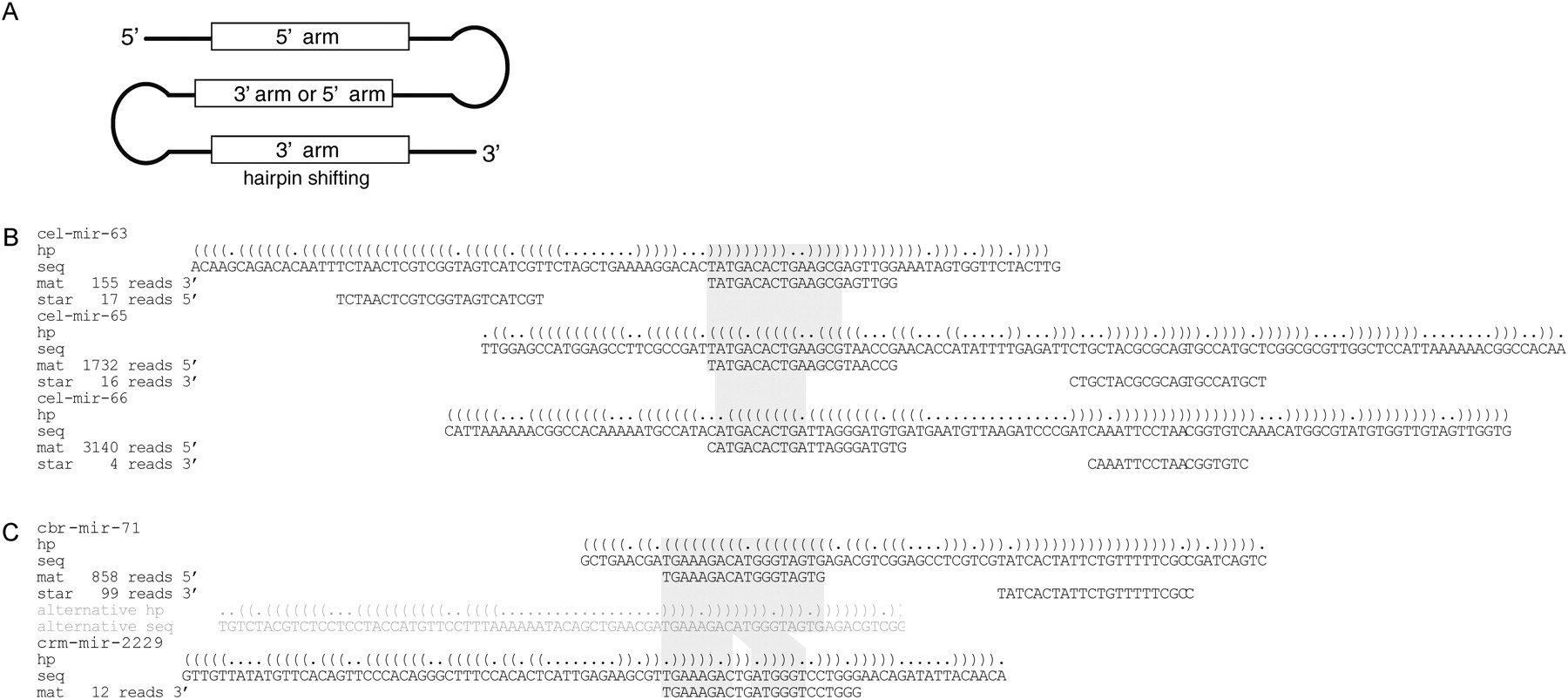
Hairpin shifting model of miRNA evolution. (A) Schematic representation of hairpin shifting. If the hairpin shifts in the 3′ direction, the 3′ arm of the existing hairpin becomes the 5′ arm of the new hairpin. With this new assembly, the original 5′ arm is lost and potentially a new 3′ arm miRNA is born. A similar mechanism shifts the hairpin in the 5′ direction. (B) In C. elegans, the first 5′ 15-nt miR-63 and miR-65 are identical; however, miR-63 originates from the 3′ arm, whereas miR-65 originates from the 5′ arm. Further divergence may have led to the birth of mir-66 and miRNA stars that are also detected from the mir-65/66 loci. Gray planes highlight identical sequence. (C) Intermediates of shifted hairpins are present alongside miRNA loci. C. briggsae cbr-mir-71 and C. remanei crm-mir-2229 are highly similar, but arise from different arms. Their common ancestry is confirmed by the observation that the 5′ flank as well as the 3′ flank of C. briggsae mir-71 can fold into a stable hairpin, as indicated by “alternative seq” and “alternative hp.”