


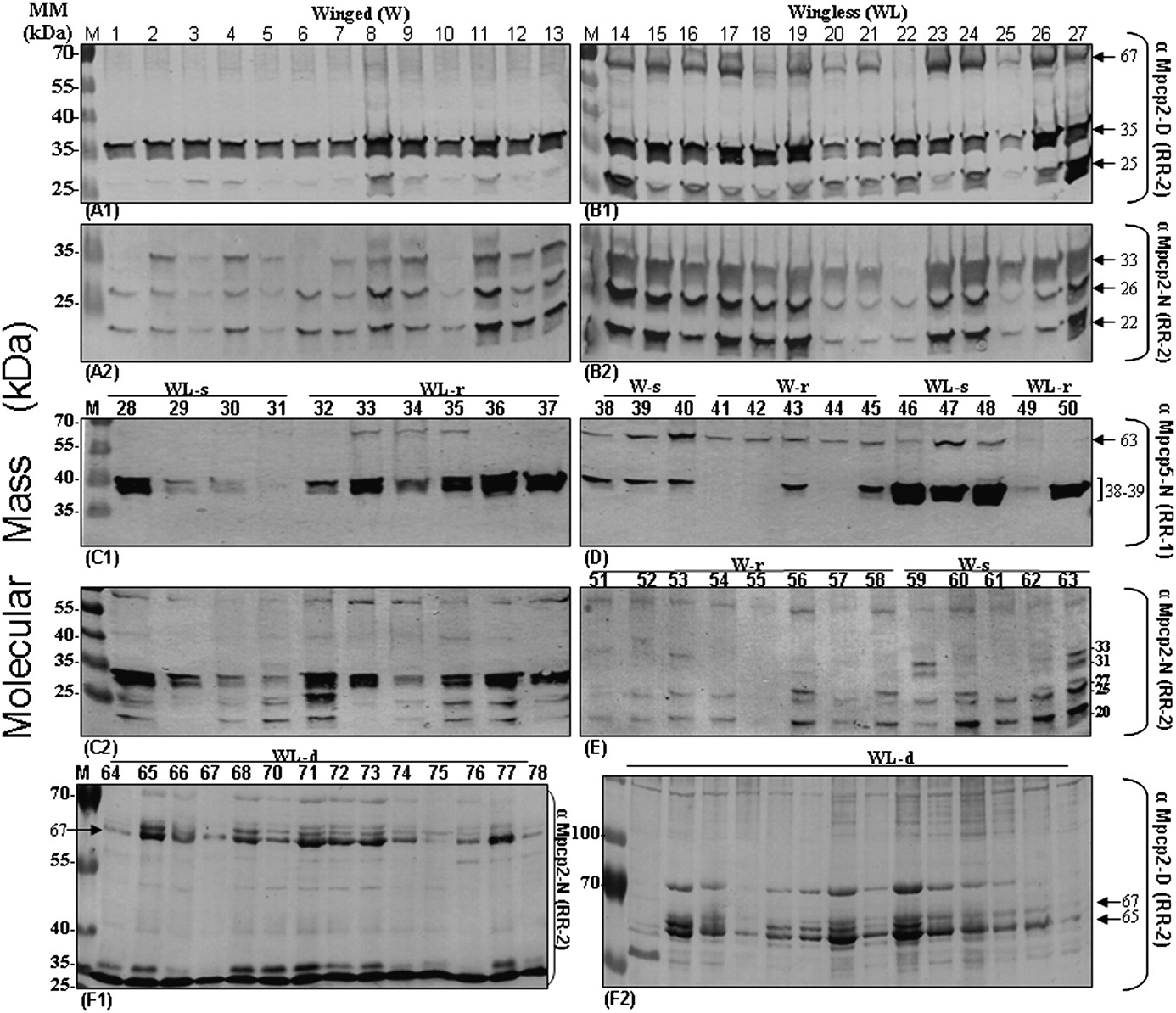
Cuticle protein profiles of individual A. pisum adults. (A–F) Extracted proteins from single aphid samples were separated by SDS-PAGE (A–E, 15%; F, 12%). Western blot analysis was then performed using four different antibodies raised against M. persicae cuticle proteins MpCPAb (1:1500). The extracts from each single aphid were resolved by equal loading onto duplicate gels. Therefore, each track within the paired gels (A1,A2,B1,B2,C1,C2,F1,F2) corresponds to one-half of the extracted protein sample from the same individual aphid. Only gels showing identical protein loading, as determined by densitometry after red Ponceau staining, were used in the analysis. Moreover, aliquots were analyzed by blue coomassie staining in parallel to assess the exact amount of protein loading in each track. The paired gels were then subjected to Western blot analysis using either the (N) or (D) αMpcp2 antibody (produced in rabbit against the native (N) or denatured (D) forms of related cuticle proteins). The same procedure was carried out using the (N) or (D) αMpcp5 antibodies. RR-2/RR-1 are the chitin binding domains of cuticle proteins used to produce the antibodies Mpcp2 and Mpcp5, respectively. Seventy-eight aphids were tested individually and gels without numbers correspond to half of numbered samples (A1,A2,B1,B2,F1,F2). W-s/WL-s, sedentary aphids (winged and wingless); W-r/WL-r, rover aphids (winged and wingless) that show exploratory behavior. The profiles A–E were obtained from pink aphids (using optimal plant conditions for propagation) and (F1,F2) from white aphids, WL-d, wingless raised on declining plants. MM, molecular mass markers.



