


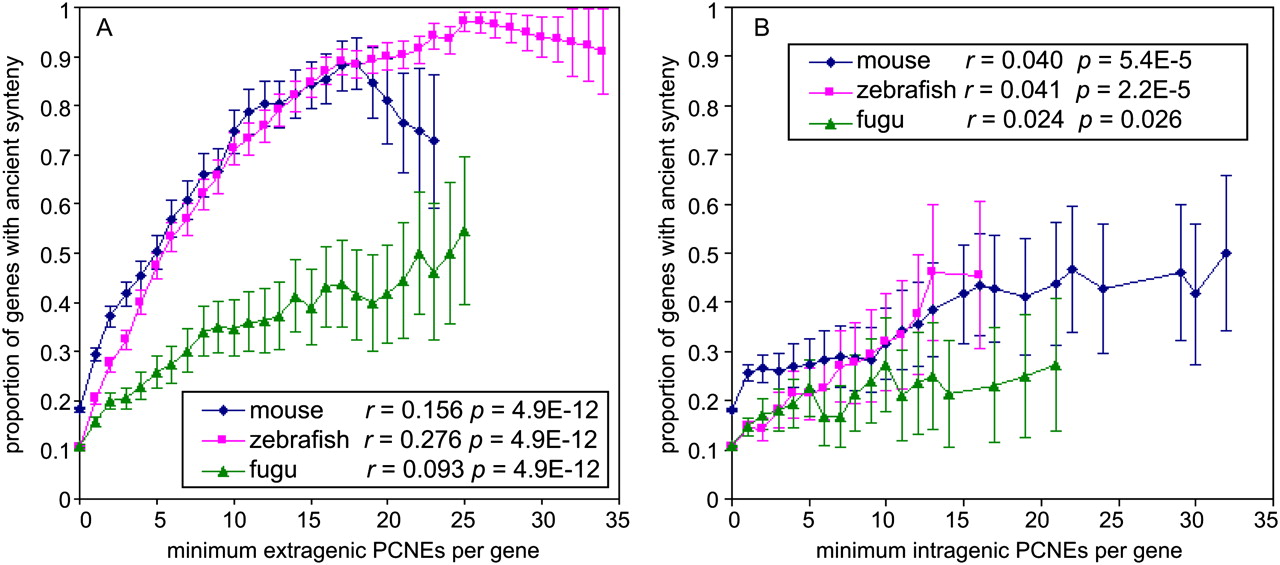
Genes linked to PCNEs are more likely to have conserved synteny. The association between PCNEs and synteny conservation in three vertebrate organisms for extragenic PCNEs (not in an intron or UTR of their associated gene) (A) and intragenic PCNEs (in an intron or UTR of their associated gene) (B). As genes are required to have a greater number of associated PCNEs (x-axis), the proportion of genes with anciently conserved synteny tends to increase (y-axis). Error bars, standard error of the proportion. Each data point is calculated from at least 10 genes. All of these trends represent a significant positive correlation between PCNE number and synteny conservation, where r is the point biserial correlation coefficient, and p is the Bonferroni-corrected probability that the true correlation is greater than zero.


