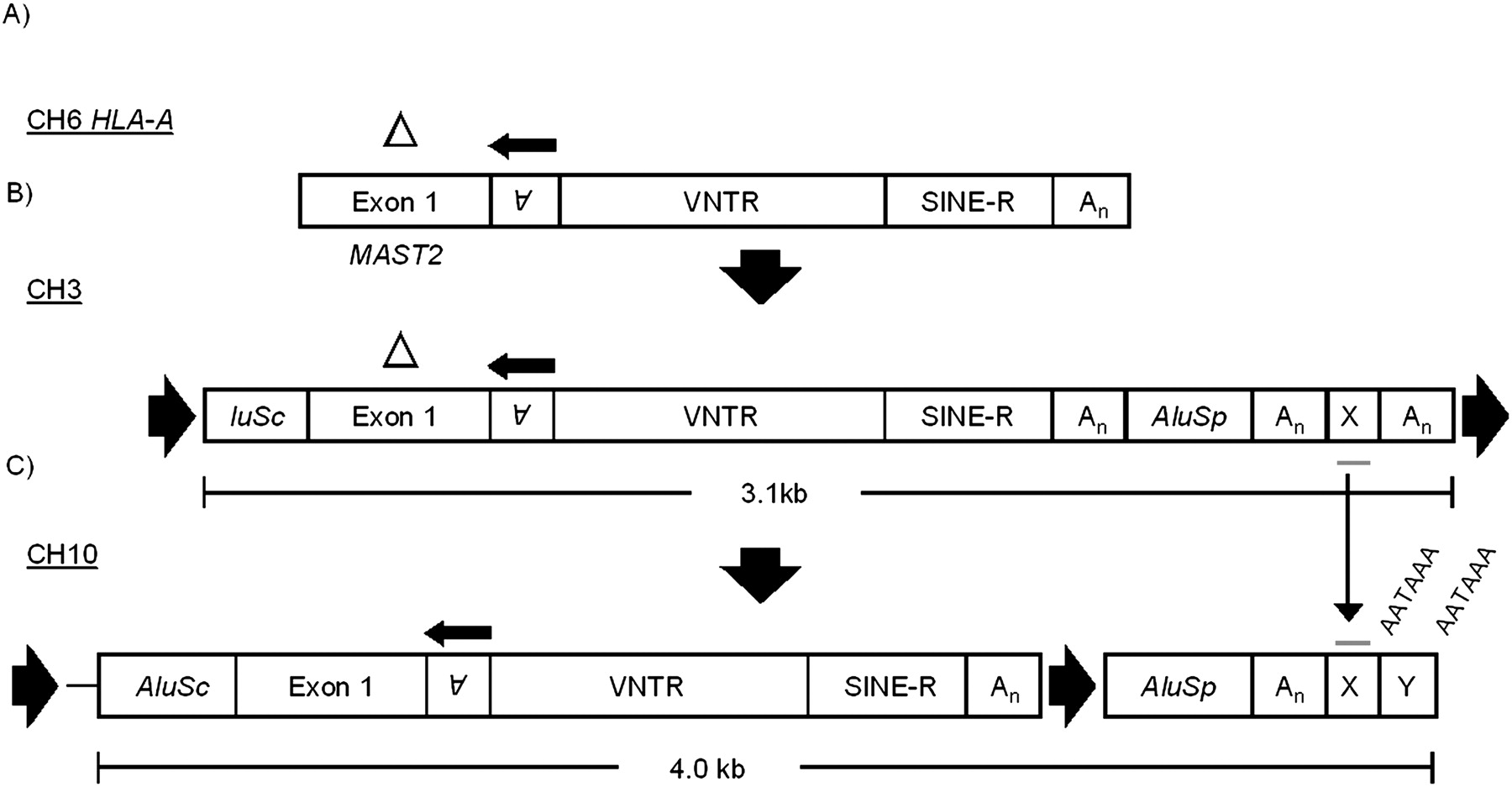
Identification of the SVA master locus on CH10. (A) The SVA insertion on CH6. The 40-bp deletion in the MAST2 sequence (△) allowed the identification of the (B) CH6 progenitor element to be identified on CH3. The SVA insertion on CH3 contains both 5′ and 3′ tranductions. At the 5′ end, the SVA contains a truncated AluSc while at the 3′ end, an AluSp along with additional sequence, indicated by X, followed by a polyA tail, with the entire insertion flanked by target-site duplications. The 3′ transduction (X, red line) on CH3 allowed the identification of (C) the master element on CH10 along with 12 additional elements derived from the CH10 locus. The SVA on CH10 contains starting at it's 5′ end: 185 bp transduction derived from CH9, a full-length AluSc, the MAST2-SVA, an AluSp, polyA tail, and then a unique sequence, which was 3′ transduced, and which allowed the identification of CH10 as the source locus. A target-site duplication flanks the insertion, which inserted on CH10. Downstream polyA signals are displayed over the X and Y transduction sequences.