


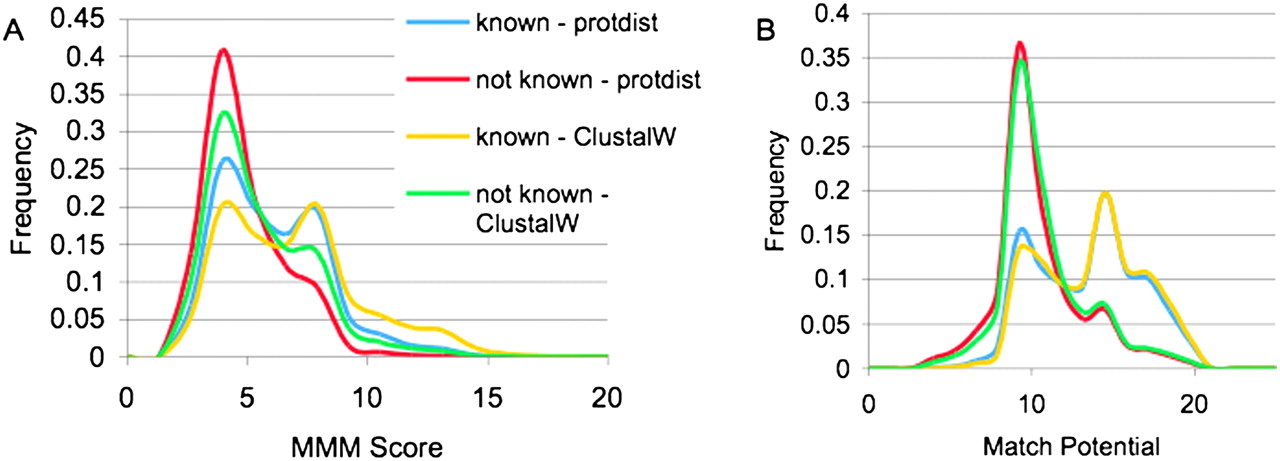
Known physical interactions have larger MMM scores. (A) The frequency distribution of MMM scores is shifted to higher values for known physically interacting proteins (blue and yellow) when compared to all matrix pairs for which no physical interaction is reported in the databases (red and green). This indicates stronger coevolution for known interacting proteins, and the difference is more pronounced when using matrices calculated with ClustalW (yellow vs. green) than with Protdist (blue vs. red). (B) Frequency distributions of the match potential, which is simply the largest possible match size theoretically obtainable in a comparison of the two matrices. The higher values seen here for known interactions indicate that these proteins are more prevalent and conserved. These plots were obtained with the MMM tolerance parameter set to 0.2 (allowance for 20% relative length mismatch) and without the use of a stepwise linear function adjusting this tolerance for extreme values of distance.


