


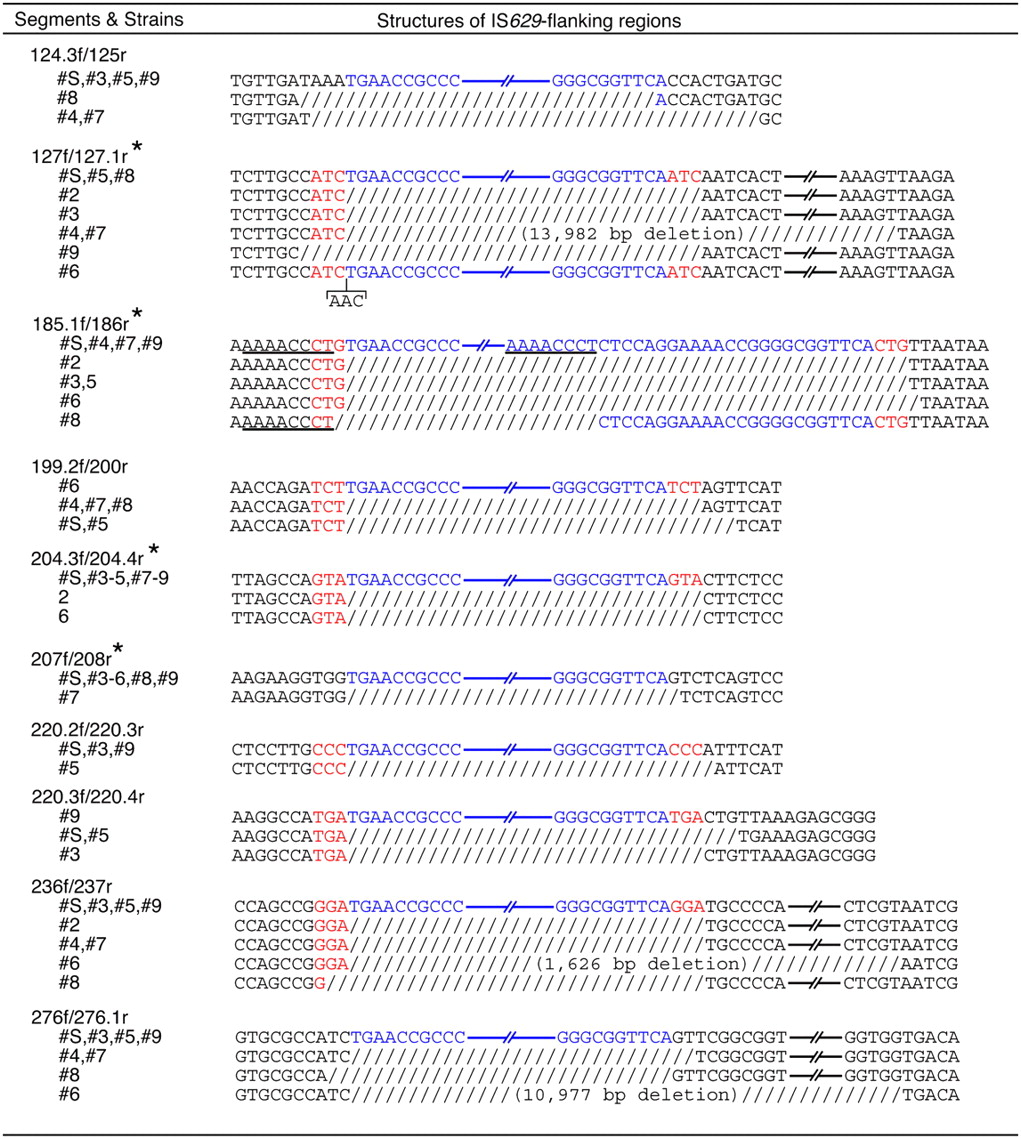
Simple excision of IS629 and the footprints generated upon excision or transposition. (Blue) IS629 sequences; (red) target site duplications (TSDs). (Slash) Deleted sequences; the size of each deletion is shown in parentheses. Homologous sequences that probably induced deletions through homologous recombination are underlined. In the four genomic loci labeled with asterisks, the phylogenetic relationships among the strains indicate that the absence of IS629 and genomic deletions in some strains were generated by a simple excision and upon the excision (or transposition) of IS629. Deletions observed at six other loci were also likely generated by a similar mechanism because they occurred precisely at IS629 insertion sites.



