


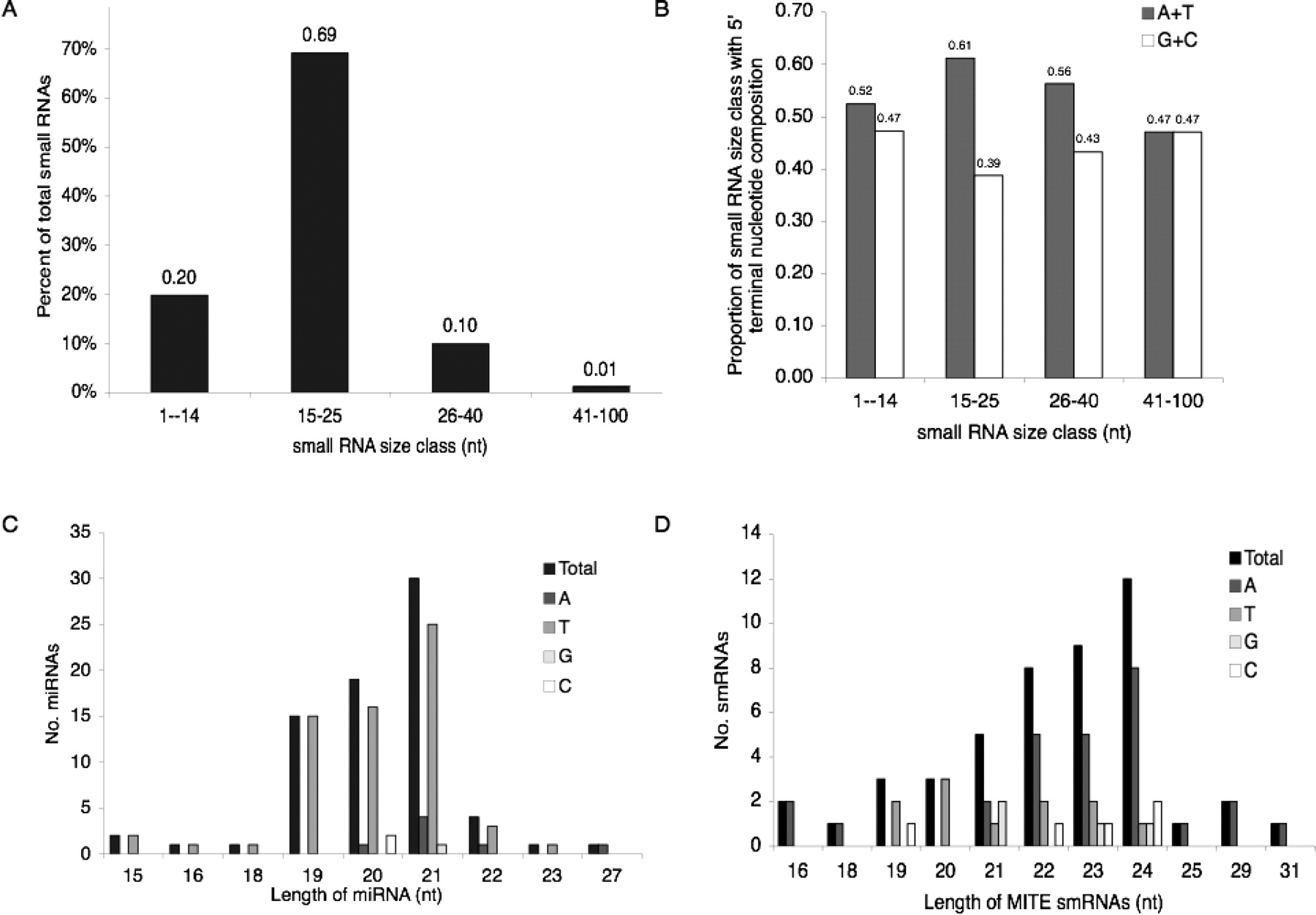
Characteristics of cloned small RNAs. (A) Length distribution of small RNAs of the total S. demissum data set (4421 smRNAs). (Black bars) Indicate the percentage of small RNAs in each size class among the total data set. (B) Proportion of the total S. demissum small RNAs within each of the four size classes with A or T or G or C as the 5′-terminal nucleotide. Within each size class, (gray bar) the portion of small RNAs with a 5′-terminal A or T; (white bars) the portion with a 5′-terminal G or C. (C) Size distribution and 5′-terminal nucleotide composition of miRNAs ranging from 15 to 27 nt in length. (Black bar) The total number of cloned miRNA in each size class. The number of miRNAs with a 5′ (dark gray bar) A, (gray bar) T, (light gray bar) G, or (white bar) C residue. (D) Size distribution and 5′-terminal nucleotide composition of MiS small RNAs ranging from 15 to 31 nt in length. The 5′ nucleotide composition is indicated as in C.



