


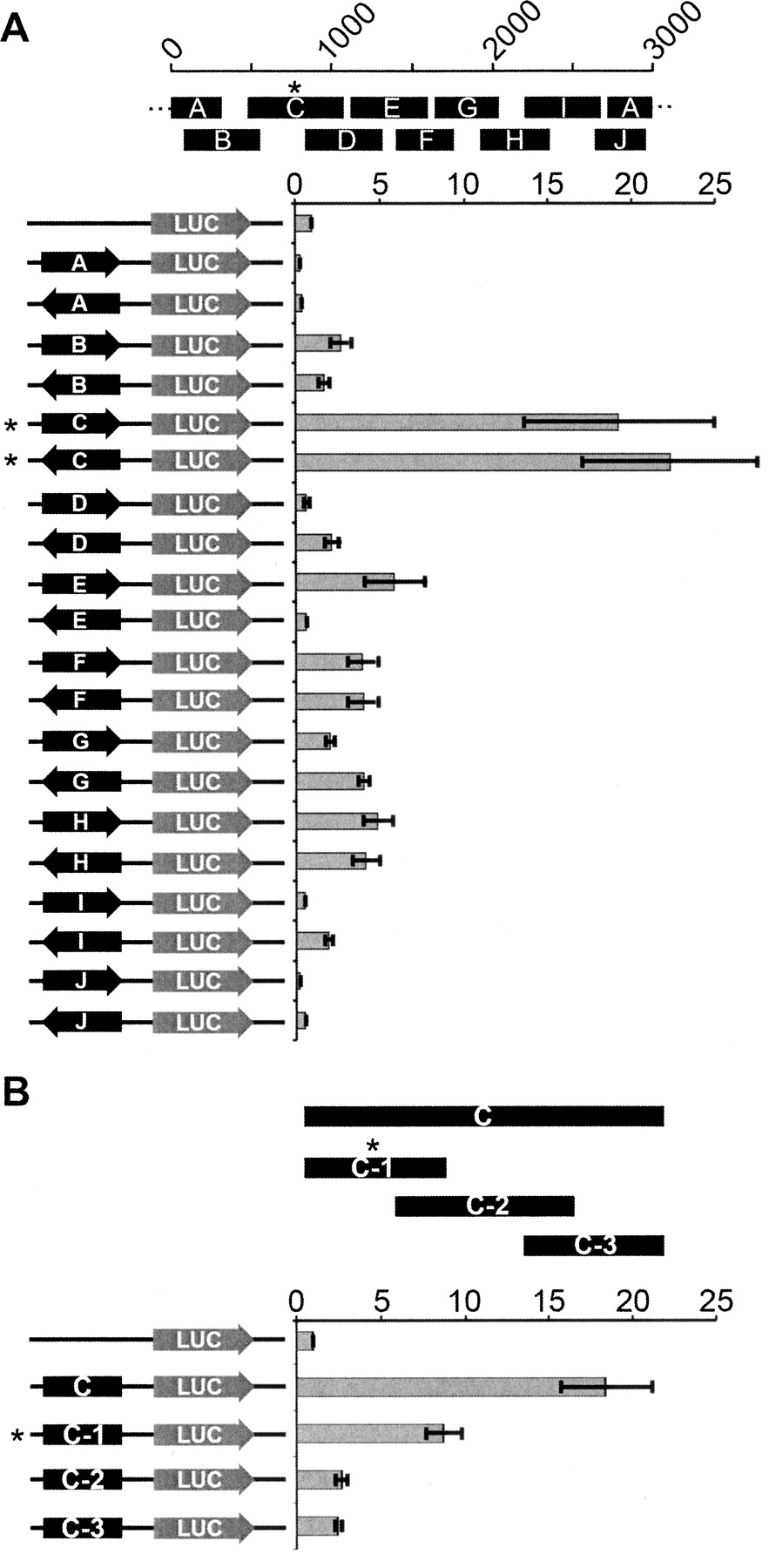
Identification of a bidirectional promoter in DXZ4. (A) A single 3-kb DXZ4 monomer is represented by 0–3000 bp scale. The approximate location of subfragments A–J are shown below the monomer. DXZ4 subfragments cloned upstream of the Luciferase reporter gene in pGL3-Basic are shown to the left. The orientation of the fragment is represented by the arrow. The level of luciferase activity detected relative to that of the empty vector (assigned a value of 1) is indicated (0–25×). (B) DXZ4 subfragment C is represented by the black solid bar, below which are shown the relative locations of the three subregions. Below are shown the five different pGL3-Basic constructs tested for luciferase activity. All data (A,B) represent the mean and standard error for four independent experiments. The asterisk highlights the subregion fragment that retained the most promoter activity.



