


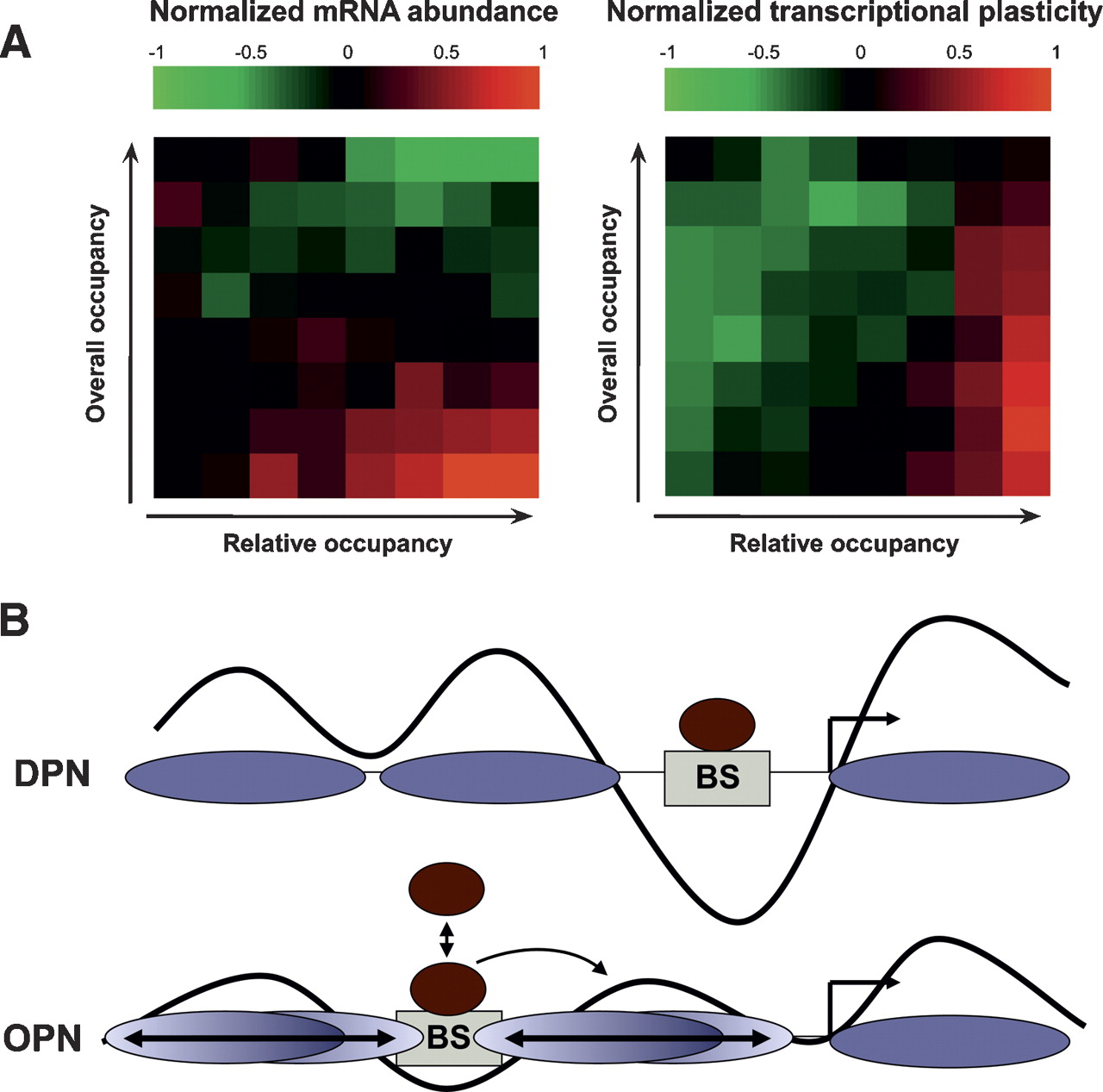
A model for nucleosome organization at low-plasticity and high-plasticity promoters. (A) Average mRNA levels are correlated with overall nucleosome occupancy, whereas transcriptional plasticity is correlated with the relative pattern of nucleosome occupancy. Genes were sorted by overall nucleosome occupancy (Y-axis) or relative pattern of nucleosome occupancy (proximal/distal; X-axis), and divided to eight bins of equal sizes. The average normalized mRNA abundance (left) or transcriptional plasticity (right) is shown for each of the 64 bins. (B) The architecture of two promoter classes. Low-plasticity (DPN) promoters tend to have well-positioned nucleosomes and a strong NFR directly upstream of the TSS. High-plasticity (OPN) genes have “fuzzy” nucleosomes whose positions are heterogenic and dynamic, perhaps as a consequence of competition with transcription factors. Binding sites are distal to the TSS, and binding of regulators to these sites may influence nucleosome positions proximal to the TSS, thus affecting transcription. (Brown circles) Transcription factors in a binding equilibrium to their binding sites (BS), (ovals) nucleosomes, (curves) pattern of nucleosome occupancy.



