


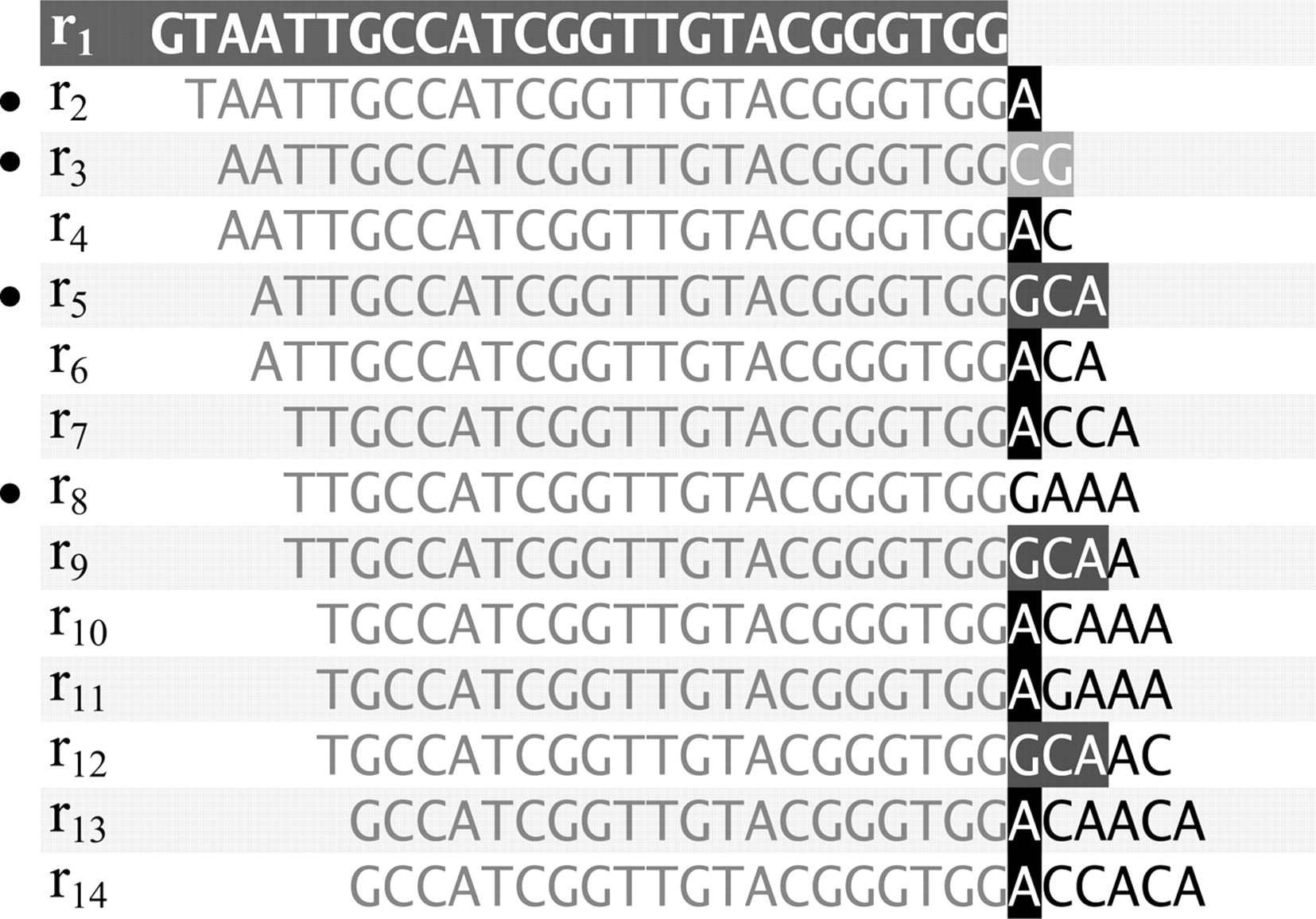
Figure 2.
Removing transitive edges. A read r1 with 13 other reads (r2 . . . r14) that overlap on its right end side are shown in the form of a multiple alignment. The overlaps that do not correspond to transitive edges are indicated with a black dot. The transitive edges removal procedure consists in discarding the overlaps that are already overlapped by another read involved in a larger overlap with r1. For example, the reads r4, r6, r7, r10, r11, r13, and r14 are overlapped by r2; they are therefore removed from the set of overlapping reads of r1. Same principle is applied to the reads r3, r5, and r8. This example is issued from a real data set of reads of 26 bases.



