


Cover image
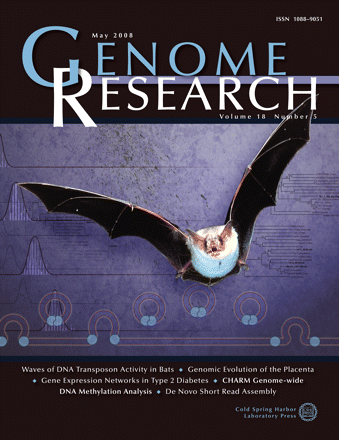
Cover The photograph shows the Greater Mouse-eared bat (Myotis myotis), a member of the vespertilionid bat family and a close relative of the Little Brown bat (Myotis lucifugus). Bats constitute more than 20% of extant mammalian species and the Vespertilionidae is the most diverse family with about 300 species distributed worldwide. Concomitantly to their diversification over the past 35 million years, vespertilionid bats have experienced successive waves of genome invasion by diverse DNA transposons, mobile genetic elements that use a cut-and-paste mechanism of transposition (schematized at the bottom). The level of recent DNA transposon activity reflected in the genome of M. lucifugus is unprecedented among mammals and at least one family still appears to be in the midst of its expansion in natural populations. (Cover illustration by Bang Wong, ClearScience, www.clearscience.info. Image courtesy of NABU/E. Menz. [For details, see Ray et al., pp. 717–728.])

