


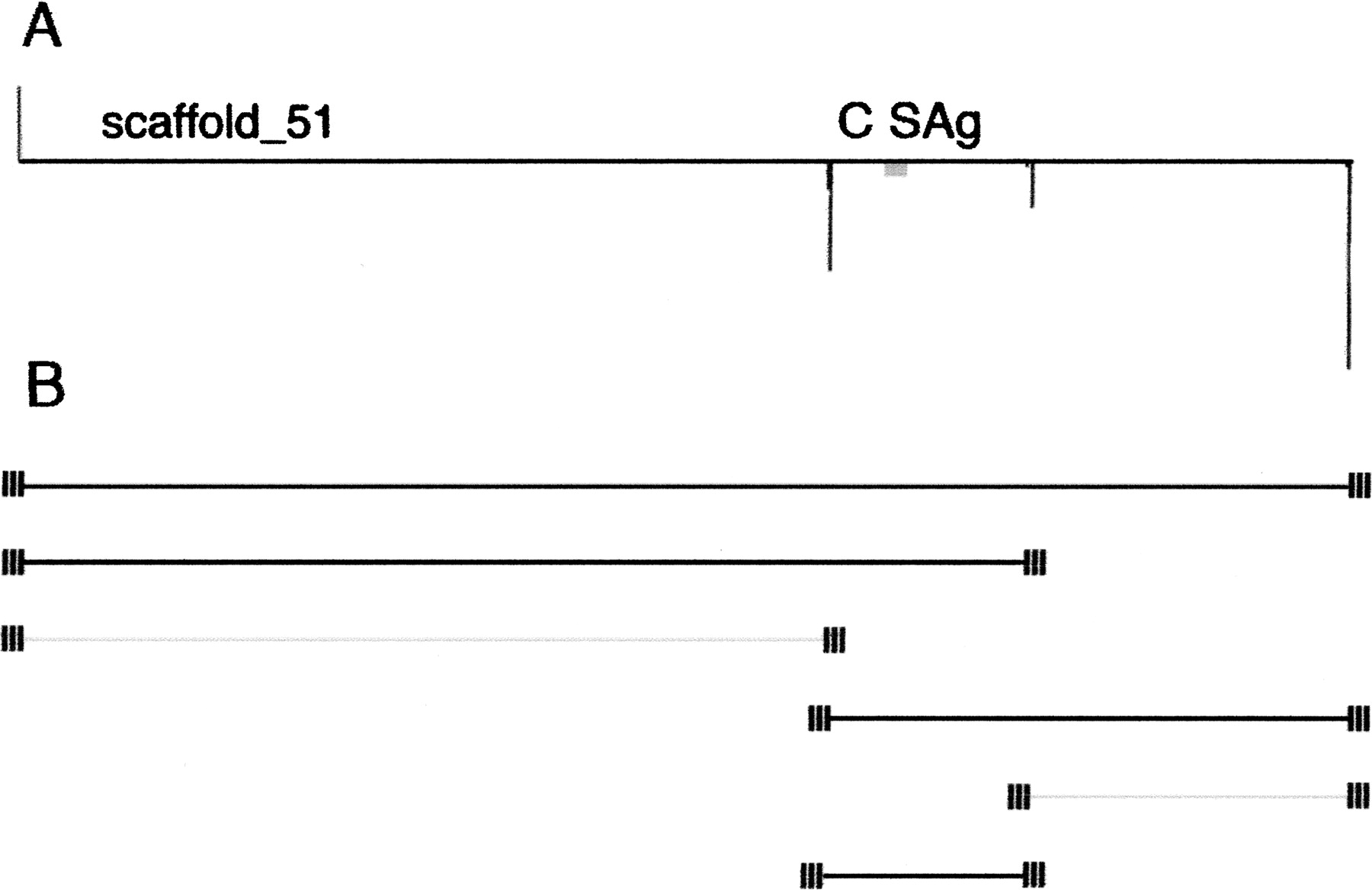
Assembled scaffolds can represent several MAC chromosomes that derive from a unique region of MIC DNA. (A) The assembly scaffold 51 is shown; remapped telomere repeats appear as vertical lines and the C SAg (GenBank accession no., M65164; ParameciumDB accession no., GSPATG00017138001) as a gray box. Note that reads with telomeric repeats map not only to the ends of this scaffold, but also to two internal locations. (B) Predicted MAC chromosomes. The prediction that six MAC chromosomes derive from the same germline region is based on the assumption that each internal telomere site corresponds to a MIC region whose elimination can lead either to fragmentation of the chromosome or to internal deletions. The small striped boxes represent the telomeres at the ends of each MAC chromosome. Chromosomes that contain the C SAg are in black, and chromosomes that do not are in gray. The prediction is in agreement with previously published experimental data showing that four MAC chromosomes hybridize with a C SAg probe (Phan et al. 1989).



