


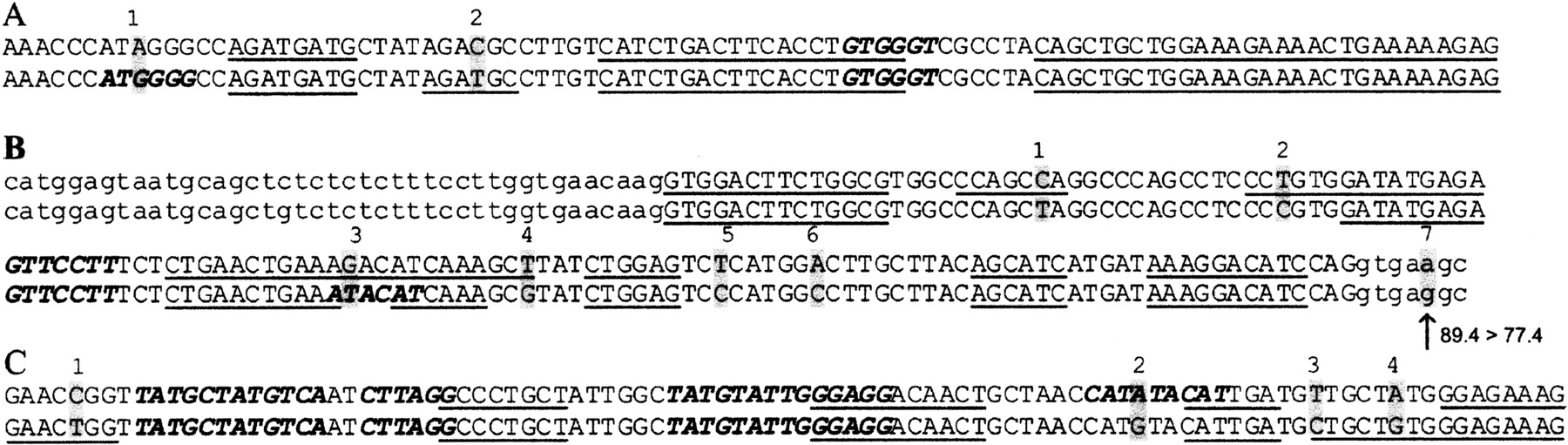
Examples of compensatory and noncompensatory changes. Top sequences are human, bottom sequences macaque. Mutations are shaded, ESEs are underlined, ESSs are in bold italics, exons are in upper case, and introns are in lower case. (A) Decrease of an ESE in human compensated by the decrease of an ESS. Mutation 2 results in the absence of an ESE, potentially compensated by the presence of an ESS (mutation 1). (B) Weakened splice site compensated by an increase of an ESE or decrease of an ESS or both. Mutation 7 weakens the 5′ splice-site CV score from 89.4 to 77.4 (arrow), while mutations 1, 2, 3, and 4 result in ESE appearances and mutation 3 disrupts an ESS as well. Mutations 5 and 6 are predicted to be neutral. (C) Decrease in ESEs and increase in ESSs with no compensation. Mutations 1, 3, and 4 disrupt ESEs and mutation 2 creates two overlapping ESSs, with no further changes in the exon.



