


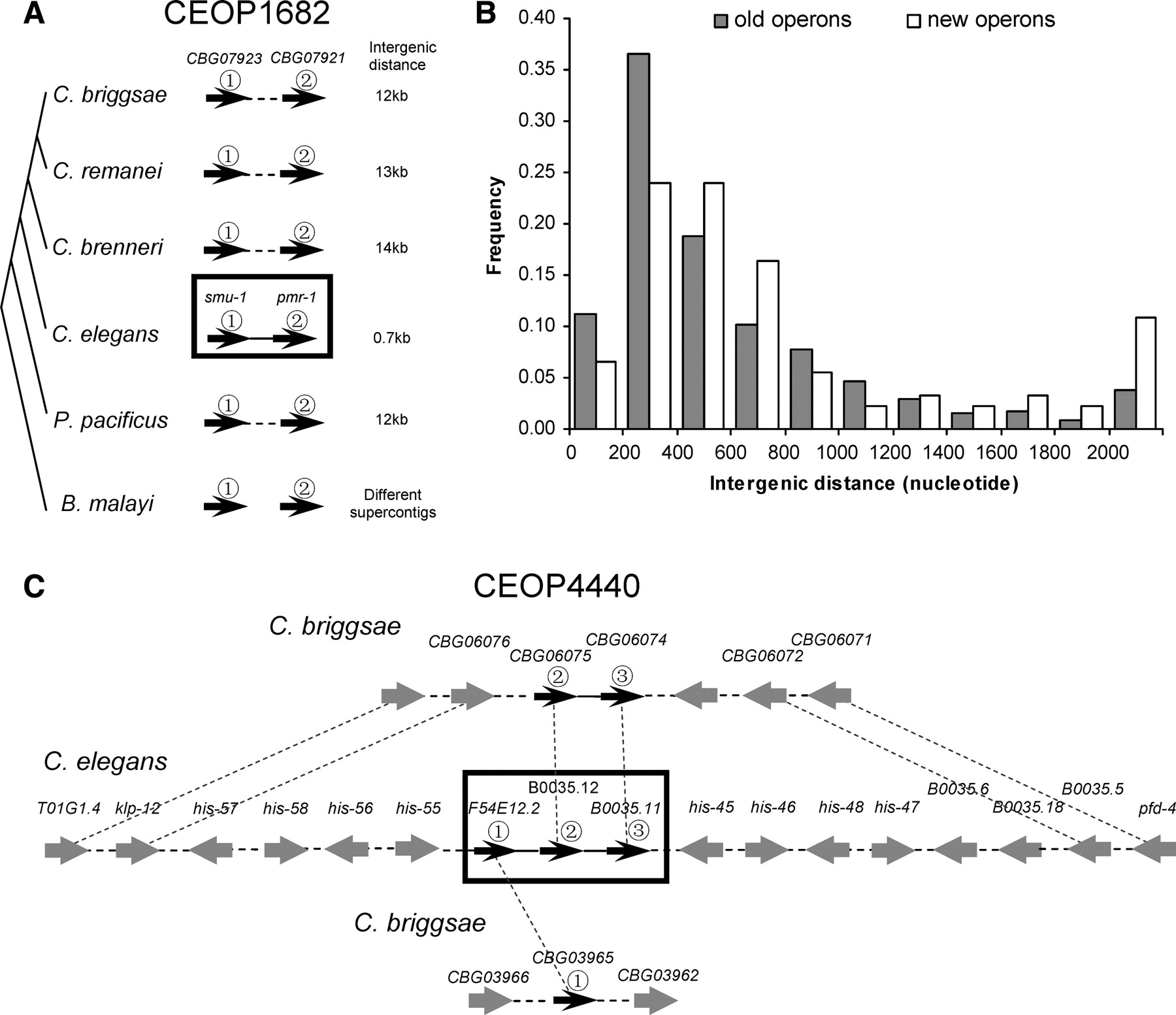
Mechanisms of operon gains. Black arrows stand for genes belonging to operons in C. elegans or their orthologs in other species, with the circled numbers above the arrows showing the order of the genes in the C. elegans operon. Gray arrows show other genes. In C. elegans, horizontal solid lines link genes belonging to the same operon (boxed) and horizontal dash lines link genes not belonging to the same operon. In other species, genes inferred to be in the same operons are linked by horizontal solid lines; otherwise, they are linked by horizontal dash lines. Dotted lines show orthologous relationship between genes. In C. elegans, Caenorhabditis Genetics Center (CGC), names or sequence names are shown above the gene model, while in other species, the names are shown if they exist in WormBase release WS182. (A) Formation of a new operon in C. elegans. (B) Comparison of intergenic distances between old operons and new operons. New operons are those formed after the divergence between C. elegans and C. briggsae, while old operons are those formed before that divergence. (C) Expansion of an existing operon by addition of F54E12.2 as the first gene in CEOP4440 in the C. elegans lineage.



