


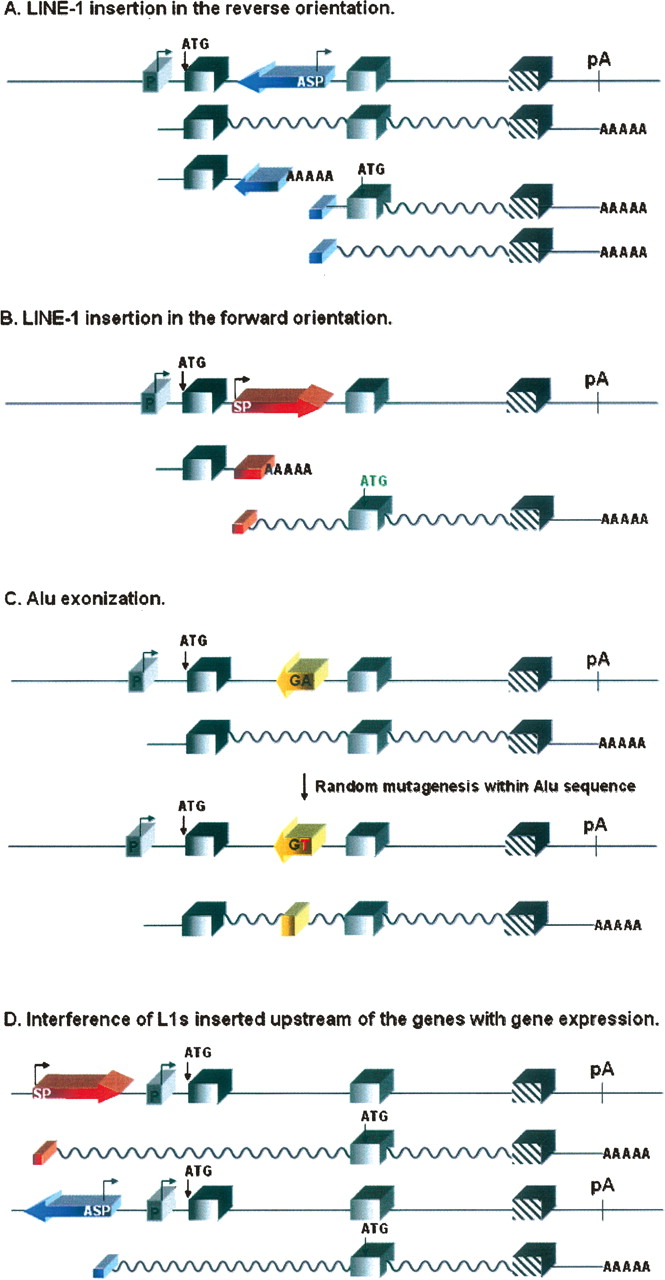
Different effects of mobile-element integration on gene expression. (A) Integration of the full-length L1 element into the intronic region in the opposite orientation relative to the gene transcription can result in premature termination of the cellular transcript due to the usage of the polyadenylation (pA) sites encoded by the L1 antisense strand. Independent of this process, L1 antisense promoter can drive expression of the gene portion located downstream of the L1 insertion site, producing a 5′-truncated mRNA. This transcript may include all of the remaining exons that are accurately spliced, or it may lack some of the exons if the L1 antisense sequence donates a splice donor site that is used with one of the normally utilized splice acceptor sites within the gene. These types of transcripts have the potential to generate proteins by initiating translation at alternative ATG. (B) A similar phenomenon is observed when a full-length L1 element inserts in the same orientation as gene transcription. In this case, usage of the pA sites present in the L1 sense strand leads to the production of prematurely polyadenylated cellular transcripts. At the same time, L1 sense promoter can drive the expression of the remaining portion of the gene resulting in the production of the mRNA that contains L1 5′ UTR sequences spliced to the exons located downstream of the L1 insertion site. Functional alternative ATGs in this portion of the RNA can lead to the translation of the truncated protein with a dominant negative effect or a gain of function. (C) Alu sequences inserted within introns can be included into mature mRNAs if they gain functional splice donor or acceptor sites via random mutagenesis of their sequence. (D) Integration of the full-length L1 element upstream of the cellular gene may also interfere with the normal gene expression due to the presence of the functional promoter activity (SP, sense promoter; ASP, antisense promoter) and splice sites in both sense and antisense strands of the L1 5′ UTR.



