


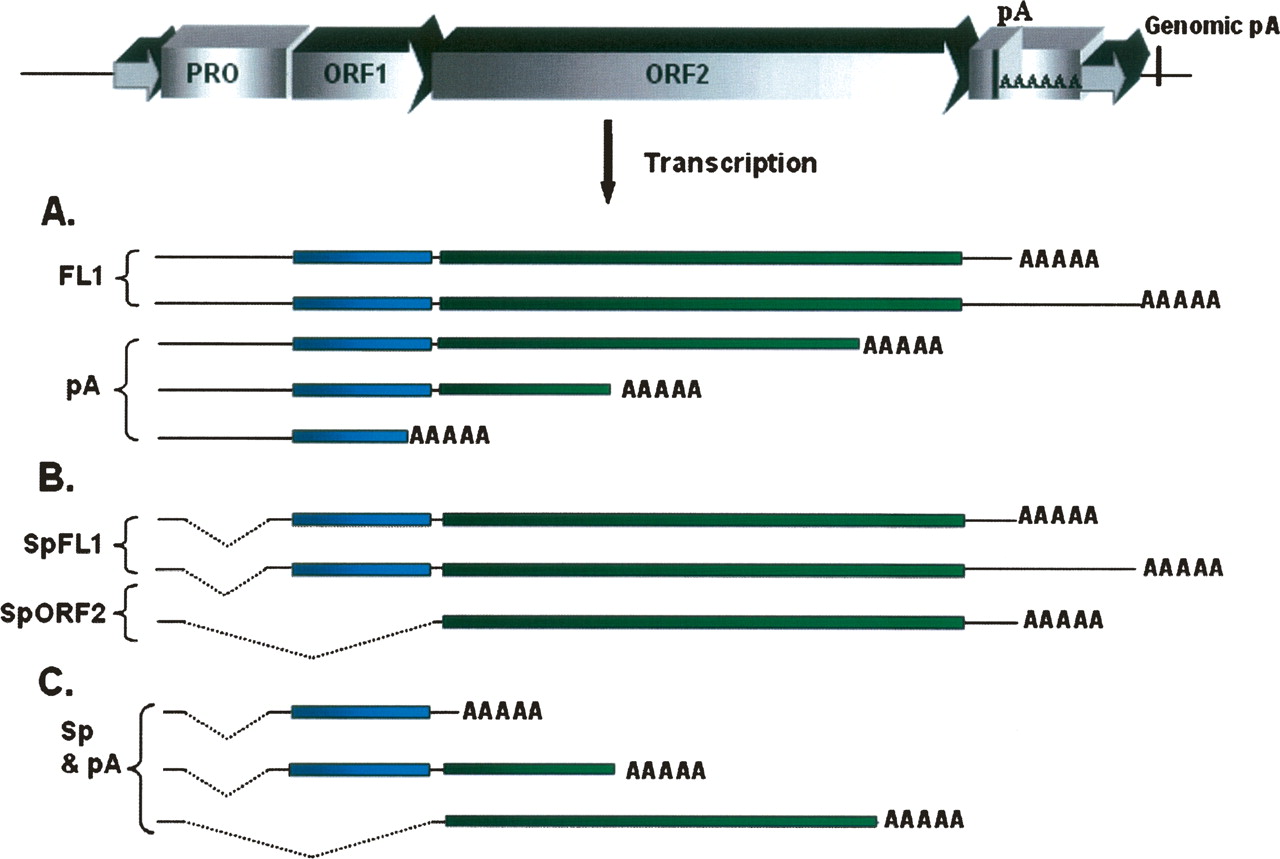
Processing of LINE-1 transcripts. (A) Schematic of two variants of the full-length retrotranspositionally competent L1 (FL1) mRNAs: One ends at the L1 encoded poly(A) signal, the other terminates at a poly(A) site within genomic DNA located downstream of the L1 sequence. These mRNAs represent a small fraction of the products that are made during L1 transcription due to premature polyadenylation of L1 transcripts at the internally positioned pA sites (pA products). (B) In addition to premature polyadenylation, L1 transcripts are also extensively spliced. This processing results in L1 mRNAs that contain both ORFs (SpFL1) and can retrotranspose at low frequency. L1 mRNA splicing also creates a transcript (SpORF2) that has a potential to produce only functional ORF2 protein independent of the full-length L1 mRNA. (C) The majority of the L1 transcripts are differentially spliced and prematurely polyadenylated (Sp & pA products).



