


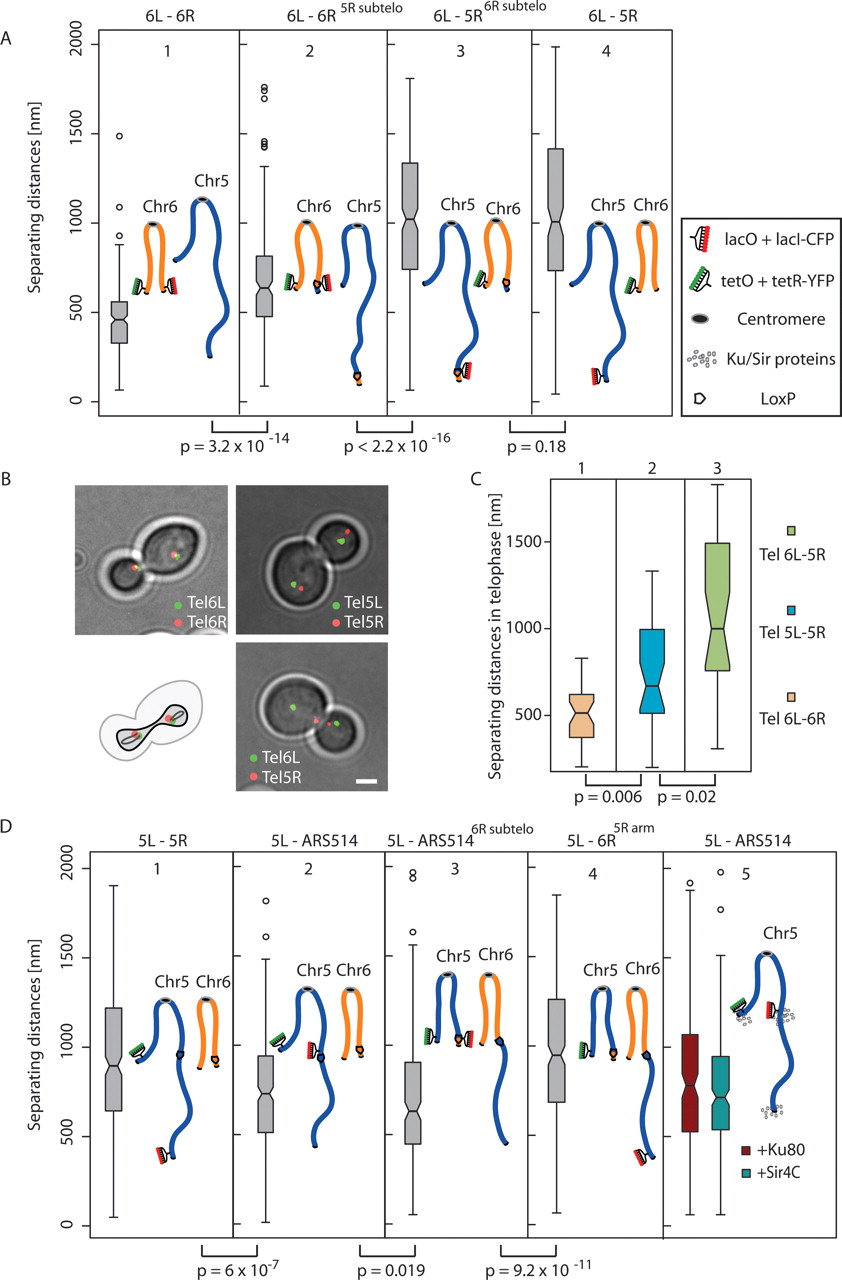
Equal chromosomal arm length and colinearity promote telomere interaction. (A) Distance distributions were determined between the indicated lacO and tetO tags inserted in isogenic strains. The results are represented as box plots as in Fig. 3. A representation of the analyzed chromosome is indicated as folded in a Rabl configuration. The relevant pairs of loci analyzed are as follows: (1) Tel6L–Tel6R (GA-958, n = 231); (2) Tel6L–Tel6R5Rsubtelo (GA-1094, n = 194); (3) Tel6L–Tel5R6Rsubtelo (GA-1095, n = 265); (4) Tel6L–Tel5R (GA-957, n = 180). (B) Superposition of a brightfield image with a maximal projection of fluorescence image stacks is shown for anaphase cells bearing differentially tagged telomeres as indicated. Bar, 2 μm. (Upper left panel) A cell bearing lacO and tetO tags at Tel6L and Tel6R, respectively (GA-958), (upper right panel) Tel5L and Tel5R (GA-3746), (lower right panel) Tel6L and Tel5R (GA-957), (lower left panel) probable configuration of chr 6 in anaphase. (C) Quantitative analysis of Tel6L–Tel 6R (GA-958, n = 36), Tel5L–Tel5R (GA-3746, n = 33), and Tel6L–Tel5R (GA-957, n = 30) in anaphase and telophase cells. The two-sample Kolmogorov–Smirnov test confirmed that the differences between the distributions are significant. (D) As in A, but box plots are shown for the following strains resulting from chromosome arm exchange: (1) Tel5L–Tel5R (GA-3746, n = 307); (2) Tel5L–ARS514 (GA-3747, n = 320); (3) Tel5L–ARS5146Rsubtelo (GA-3749, n = 211); (4) Tel5L–Tel6R5Rarm (GA-3748, n = 296); (5) Tel5L–ARS514 (GA-3689) in cells expressing either LexA-Ku80 or LexA-Sir4, which then bind ARS514 bearing 8× LexA binding sites.



