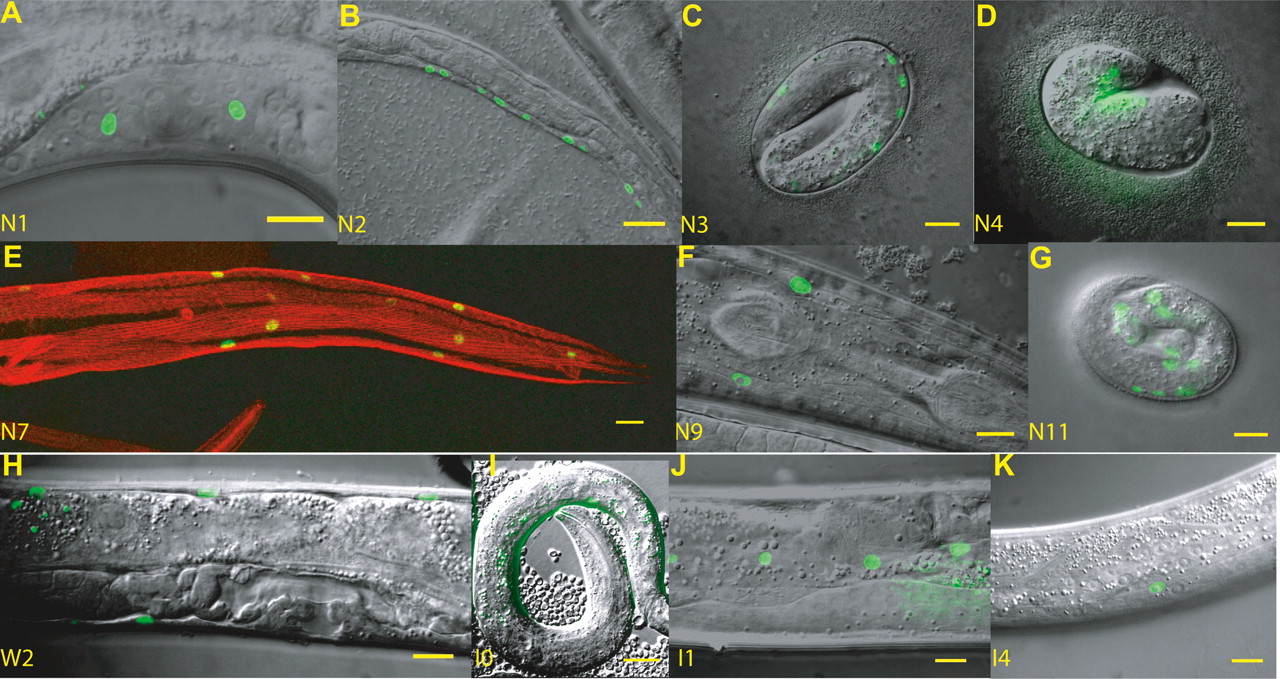
In vivo expression patterns. Many well-conserved and some poorly conserved regions drive independent and reproducible expression. Expression is observed in a variety of tissues that largely agree with published antibody staining for ceh-13 and lin-39. (A) Element N1 directs expression in the L4 to adult vulval muscles. (B) Element N2 directs expression in the late embryo through L2 in the ventral nerve cord and P cells. (C) Element N3 directs expression in late embryonic through L3 hyp7, and in the V cells and P cells soon after hatching. (D) N4 directs expression in cells of the AB lineage in the dorsal mid-body during the comma stage. (E) N7 directs expression in the posterior bodywall muscle in the late embryo through the adult. N8 contains mir-231 and was not assayed. (F) N9 directs expression in the anterior bodywall muscle in the adult. (G) N11 directs expression in anterior late embryos. (H) W2, a large region spanning N7, N8, and N9, directs expression in both the anterior and posterior bodywall muscles, demonstrating additive coexpression of N7 and N9. (I) I0 directs expression in the posterior ventral coelomocyte. (J) I1 directs expression in the seam cells. (K) I4 directs expression in the SM cells. All scale bars are equal to 10 microns. For background expression from the reporter, see Supplemental material and Supplemental Figure S4.