


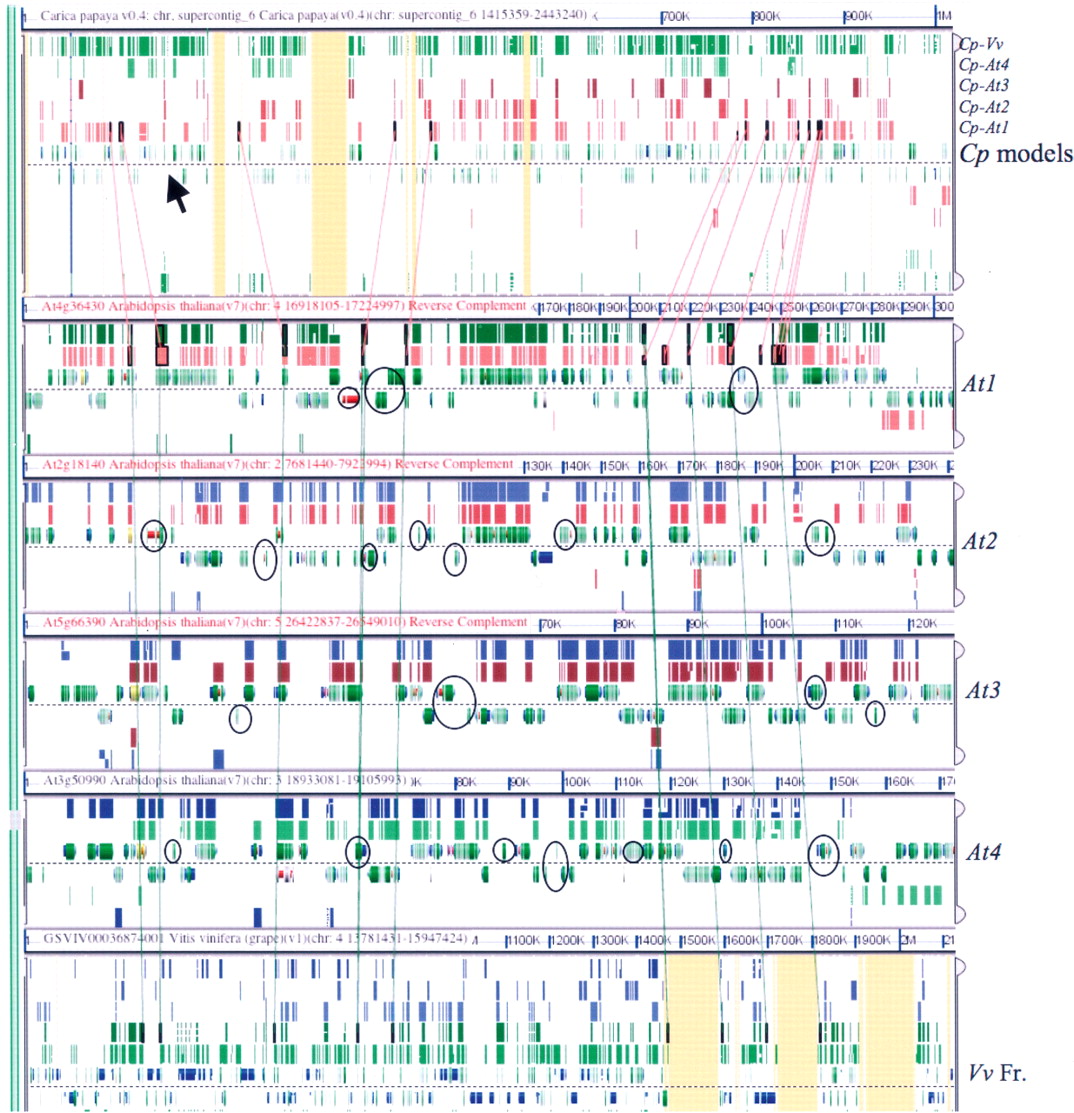
A GEvo graphic of a BLASTZ six-way multiple alignments including one syntenous region from Cp, the four homeologous (orthologous) At regions, and the orthologous Vv segment. Both Cp (top) and Vv (bottom) are references, so a maximum of five high-scoring pairs (HSPs, colored boxes) could be piled above, or, for inversion, below the gene models. If syntenic lines connecting HSPs could be drawn without obscuring the graphic, essential collinearity of all HSPs would be demonstrated. The arrow in the Cp panel marks a Cp gene that is present in the expected syntenic position in Vv, and is present in all four At homeologs, meaning that the gene was retained following both α and β tetraploidies in the At-specific lineage. The other Cp genes tend to be on one, two, or three of the four possible At homeologs, reflecting various patterns of fractionation. At genes that are flanked by ancestral genes but are not hit by BLASTZ in either outgroup in this region are circled. These are candidate transpositions. Unsequenced nucleotides, n’s, are marked orange. Continue research at http://tinyurl.com/23lybd.



