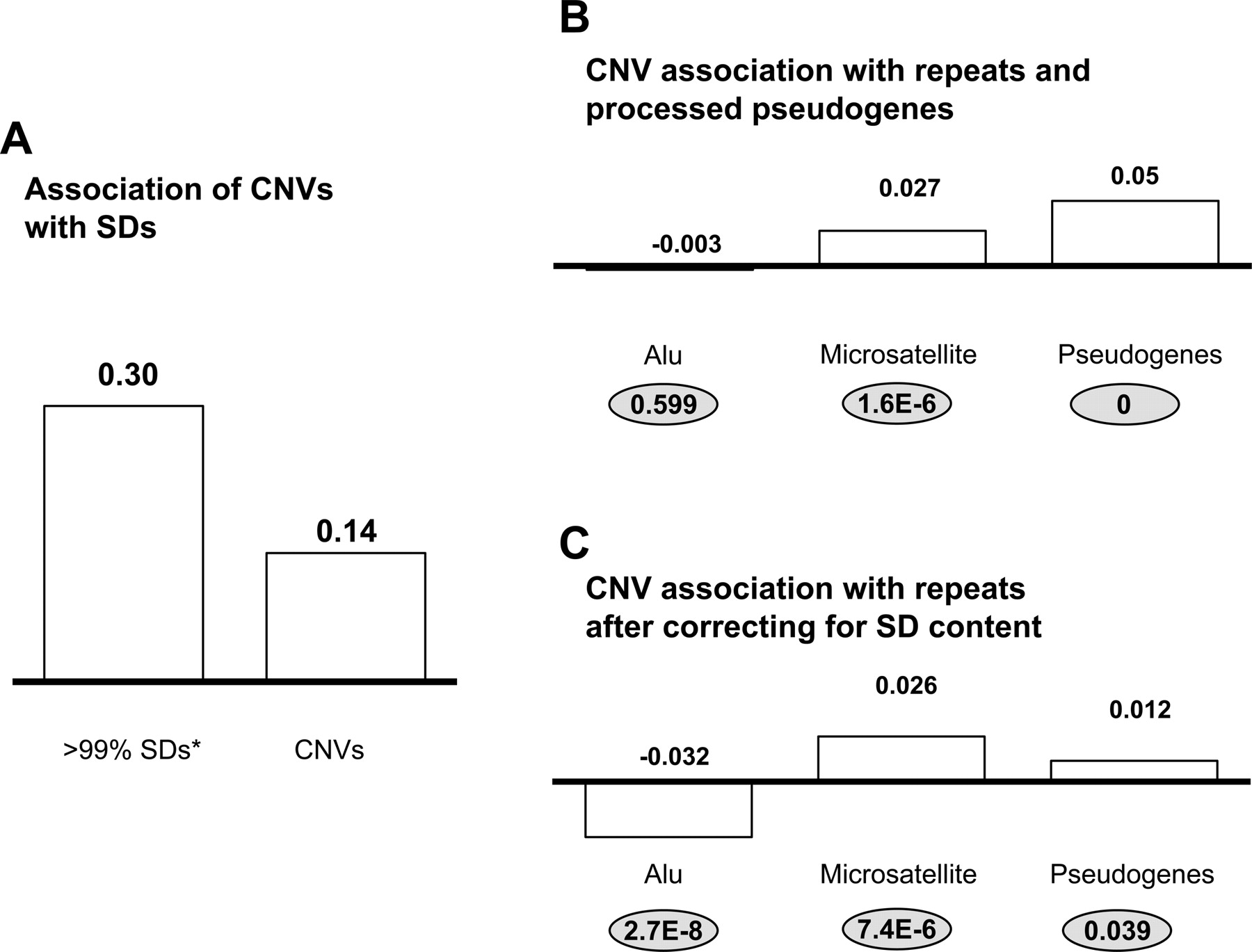
(A) Association of SDs and CNVs. Shown is the association of SDs (90%–99% sequence identity) with (left bar) “young” SDs (>99% sequence identity) and (right bar) CNVs. CNVs colocalize with SDs, but much more weakly than with very young SDs. Associations are given as Spearman rank correlations of the number of occurrences in genomic bins. All correlations are highly significant (P-value ≪ 0.00001). (B) CNV association with different human repeat elements. CNVs associate weakly with L1 elements and microsatellites, but show no association with Alu elements. (C) CNV association with human repeat elements after correcting for SD content. There is almost no significant association; the observed depletion in Alu elements may be due to a preference of CNVs for subtelomeric regions. Associations are given as Spearman rank correlations of the number of occurrences in genomic bins. P-values of the correlations are given in the bubbles.