


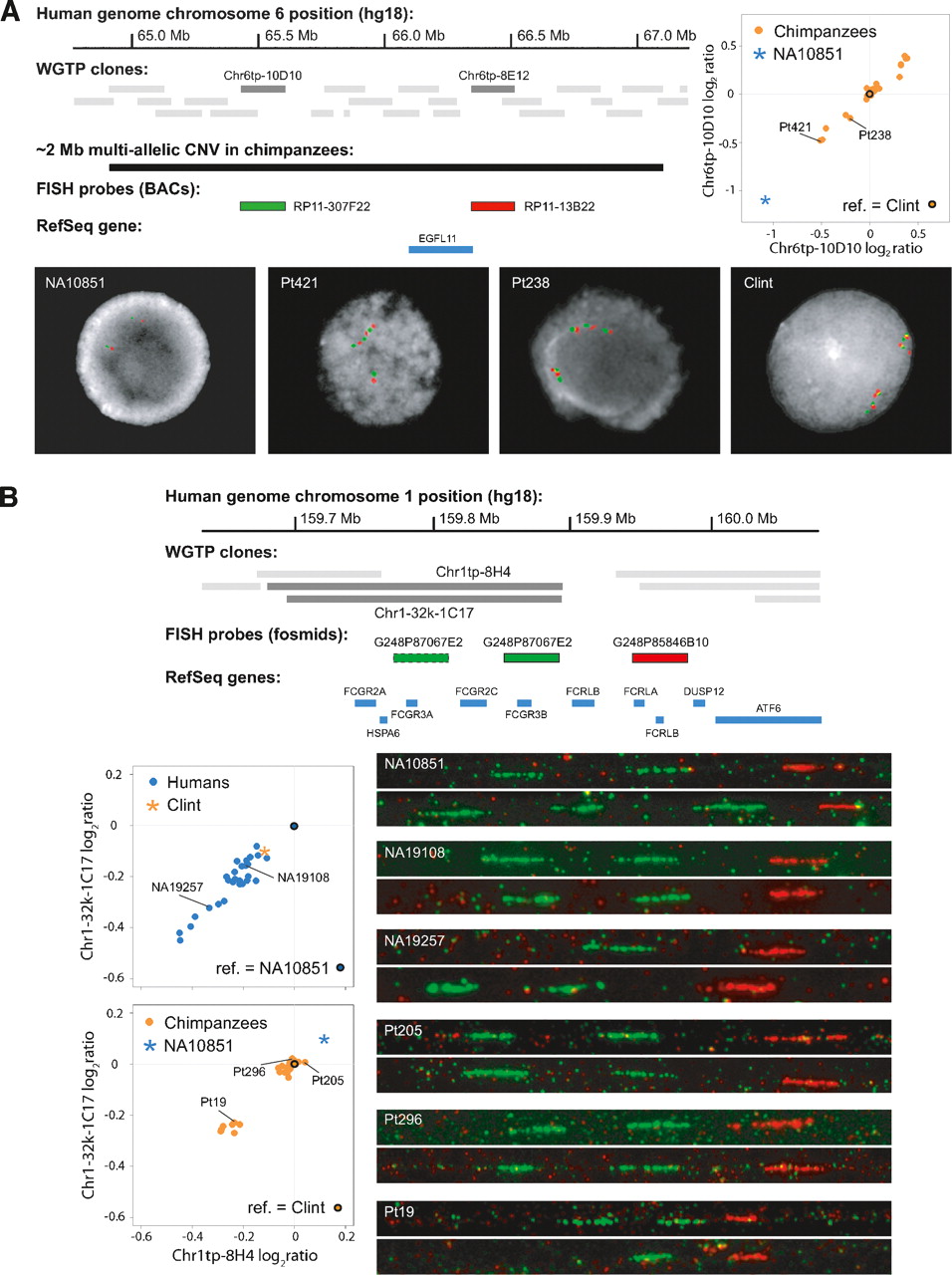
Validation of CNV loci by fluorescence in situ hybridization. (A) An ∼2-Mb region encompassing the EGFL11 gene (human chromosome region 6q12) is copy-number variable in chimpanzees. The relative intensity log2 ratios for clones throughout this region form four discrete clusters. In addition, there is a relatively large log2 ratio difference between the human and chimpanzee reference individuals (ref., reference). Interphase FISH experiments with two labeled BAC probes (RP11-307F22 in green; RP11-13B22 in red) confirmed the presence of an extremely large, tandem, multi-allelic CNV in chimpanzees. The human reference individual NA10851 was found to have two diploid copies (one copy on each chromosome). The chimpanzee log2 ratio clusters correspond to four (Pt421; 1 + 3), five (Pt238; 2 + 3), six (reference chimpanzee Clint; 3 + 3), and presumably seven copies of this genomic region per diploid cell. (B) The WGTP clones Chr1tp-8H4 and Chr1-32k-1C17 (human chromosome 1q23.3) report CNVs in both humans and chimpanzees. This region includes the FCGR2 and FCGR3 genes, and HSPA6. Fiber FISH experiments with two labeled fosmid probes (G248P87067E2 in green; G248P85846B10 in red) validated the WGTP results and determined absolute copy numbers of the FCGR3 genes, which have been associated with susceptibility to systemic autoimmune diseases (Fanciulli et al. 2007). The human reference individual NA10851 has five diploid FCGR3 copies (3 + 2), while the other humans apparently have either four (e.g., NA19108; 2 + 2) or three (e.g., NA19257; 2 + 1) copies per diploid cell. Chimpanzees have either four (Pt205 and Pt296; 2 + 2) or three (Pt19; 2 + 1) diploid copies of this genomic region.



