


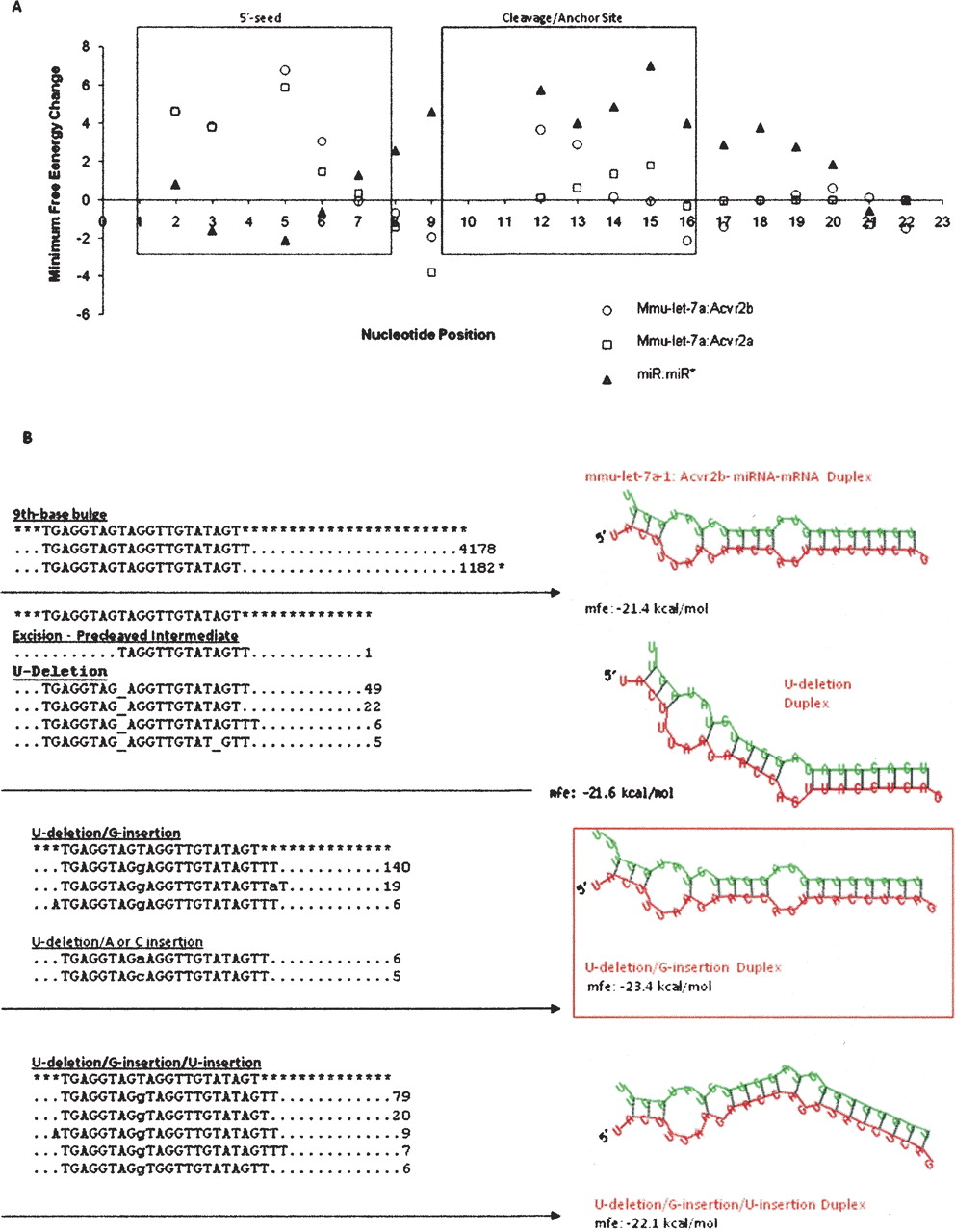
(A) Impact of internal modifications on the let-7a-1:Acvr2a/b duplexes. This panel summarizes the average minimum free energy change (Δmfe) that results from the full set of nucleotide edits at that position. The complete data that were used to compute the averages can be found in Supplemental Table ST11A,B. Here we see that modifications in the duplexed regions (nucleotides 2–8, 10–15) are rare and result in a net increase in mfe and decrease in stability. In contrast, nucleotide edits in bulge regions, including nucleotide positions 9 and 16 and above, result in a net decrease in mfe and increase in stability. In contrast, we see an increase in mfe at the ninth position in the miR:miR* duplex. We do not observe any edits for positions 4, 10, or 11 in mmu-let-7a, and hence these positions do not have associated values in the graph. (B) Intermediates and final products of ninth nucleotide edits associated with the mmu-let-7a-1:Acvr2. This panel shows the minimum free energy and secondary structure of let-7a-1 species that possibly represent intermediates and end products of a U-deletion/insertion reaction. Edited sequences with copy numbers denoted at the end of the dotted line and the wild-type unedited miRNA denoted by an * are shown on the left panel. We find sequences that are consistent with excision intermediates, U-deletion products following religation, U-deletion/G-insertion products, and U-deletion/G-insertion/U-insertion products. All of these products exhibit a lower duplex mfe than the mature miRNA without edits (mfe = −21.4 kcal/mol). The U-deletion/G-insertion product that occurs at the highest copy number is also the most stable, with an mfe of −23.4 kcal/mol.



