


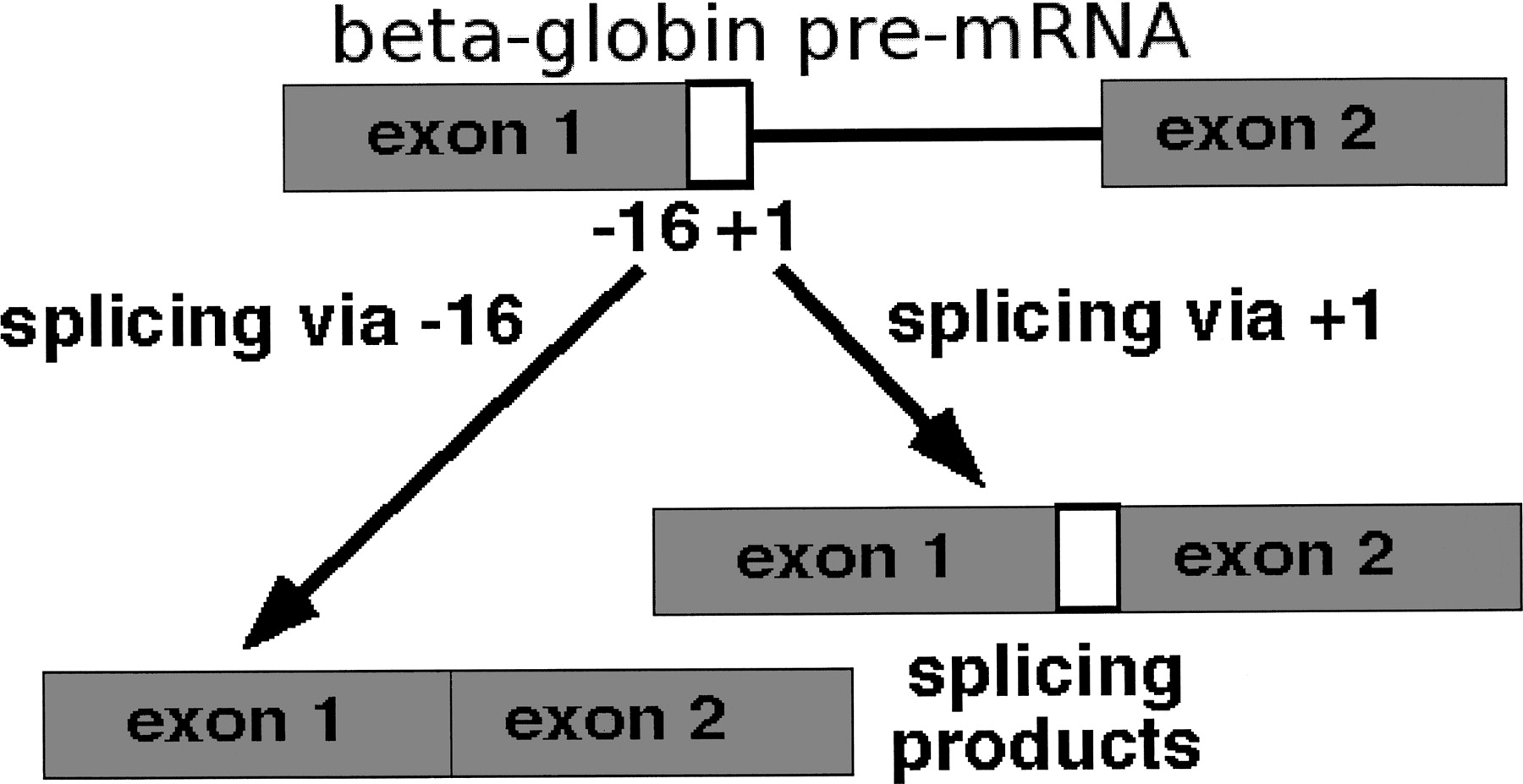
Experimental system used to test 5′ss efficiency by a competition assay (Roca et al. 2005). The human beta-globin pre-mRNA has two 5′ss at positions −16 and +1, of which the +1 5′ss is always used because the −16 cryptic 5′ss is much weaker (Roca et al. 2003). Replacement of the −16 5′ss by the +1 5′ss sequence results in both 5′ss being used equally. This system can be used to test the relative efficiencies of 5′ss by a competition assay, wherein the −16 and/or +1 5′ss are replaced by the various 5′ss to be tested. When different 5′ss are compared, their relative positions are also swapped as the contexts are not equivalent, in that for 5′ss of comparable efficiency, either the +1 or the −16 site can get more efficiently used. Use of the two competing 5′ss results in products that differ in length, which is detected by gel electrophoresis.


