


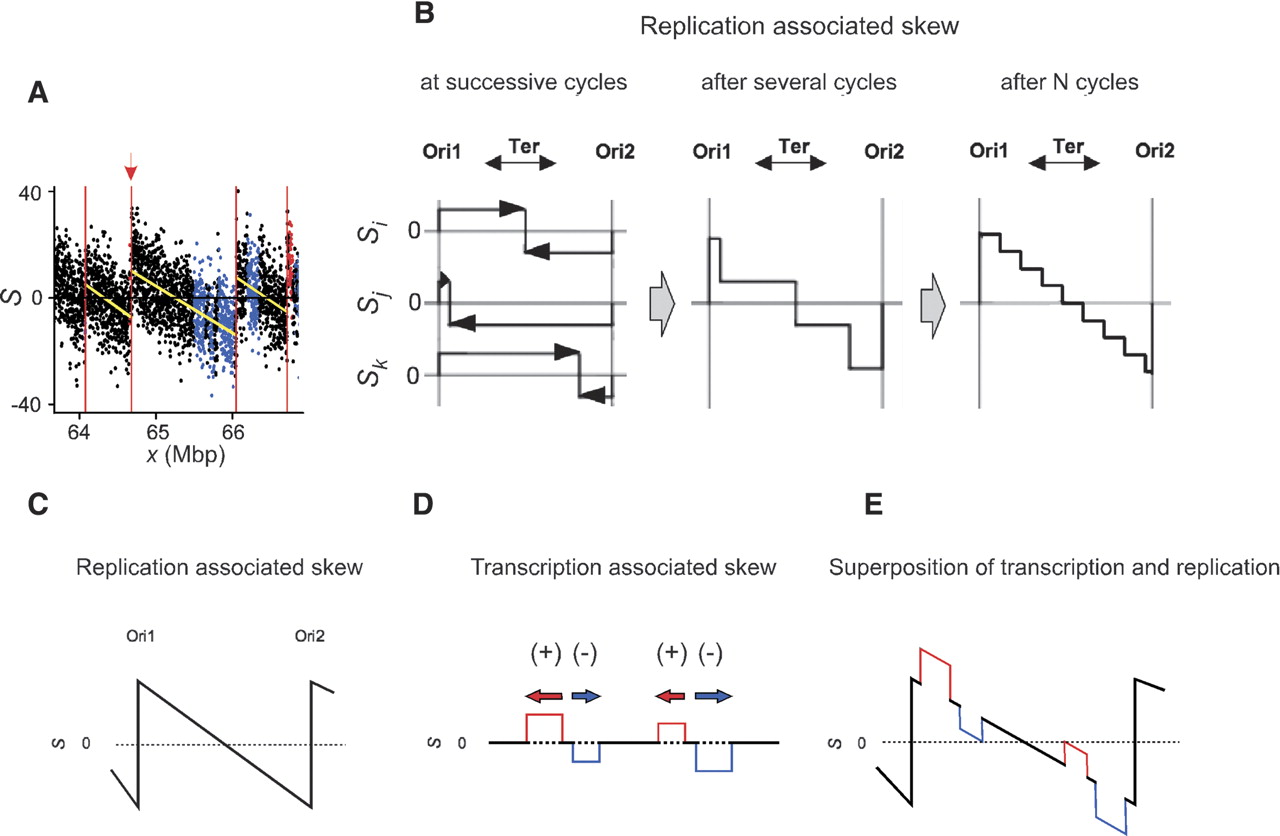
Factory-roof pattern of the skew profile. (A) Skew (S) profile around an experimentally identified replication origin. The skew is computed along a DNA fragment containing the experimentally determined replication origin associated with the MYC gene (Vassilev and Johnson 1990) (red arrow). S is computed in 1-kbp adjacent windows of masked sequences; (red) + genes (coding strand identical to the Watson strand); (blue) − genes (opposite direction); (black) intergenic regions (the color of each point is defined by the majority rule). In abscissa, the position on the sequence; in ordinate, the skew, S, in percent. (Red vertical lines) Putative replication origins associated with upward transitions of the S profile. (B–E) Working model of the factory-roof pattern of the S profile. We propose that this pattern results from the superimposition, in germ-line cells, of strand asymmetries associated with replication and transcription. (B) Model of the replication-associated skew profiles corresponding to two fixed putative adjacent replication origins, Ori1 and Ori2, and to a replication termination site (Ter) occurring with equal probability between Ori1 and Ori2 (adapted from Touchon et al. 2005). Upward or downward jumps of the S profile correspond to the origin and termination positions, respectively. (Left) Three elementary skew profiles, Si, Sj, and Sk, are associated with three successive replication cycles and display three different Ter positions. (Middle) Superimposition of the Si, Sj, and Sk profiles. (Right) Superimposition of a large number of elementary skew profiles, ultimately leading to a pattern decreasing linearly in the 5′ to 3′ direction; note that reverse complementation of the sequence leaves the factory roof structure intact. (C) Final replication-associated skew profile. (D) Transcription-associated skew profile showing positive step-like blocks at + gene positions and negative step-like blocks at − gene positions. (E) Superimposition of the replication- and transcription-associated skew profiles producing the final factory-roof pattern that defines the N-domains.



