


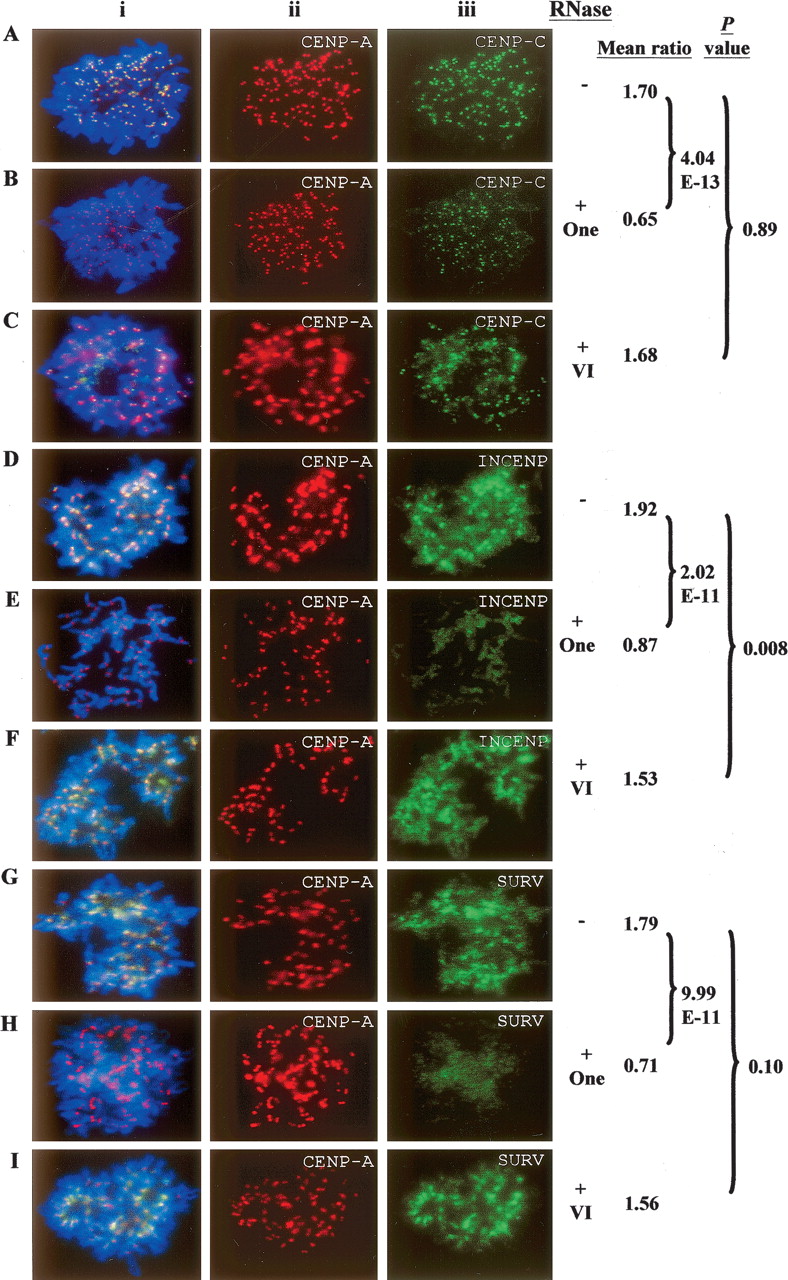
Effect of single-stranded RNA-specific RNaseOne and double-stranded RNA-specific RNaseVI treatment on the localization of centromere proteins on HeLa metaphase chromosomes. The comparison of the immunofluorescence signals for 25 cells with (+) and without (−) RNaseOne treatments by scoring the signal intensities on five chromosomes for each cell. Each data set was normalized against the CENPA signal (Aiii–Iii; red) and expressed as “mean ratio.” RNase A treatment led to a significant reduction (P-value < 0.001) for immunofluorescence intensities for CENPC1 (Aiii,Biii; green), INCENP (Diii,Eiii; green), and survivin (SURV) (Giii,Hiii; green). As with the RNase or RNaseA treatment shown in Figs. 4 and 5, signal reduction on the centromeres was less complete for CENPC1 compared with CENPA, INCENP, and survivin. Similar pairwise comparisons indicated no significant difference in mean immunofluorescence signals before and after RNaseVI treatment for CENPC1 (Aiii,Ciii; green), INCENP (Diii,Fiii; green), and survivin (SURV) (Giii,Iiii; green). (i) Merged images of ii and iii.



