


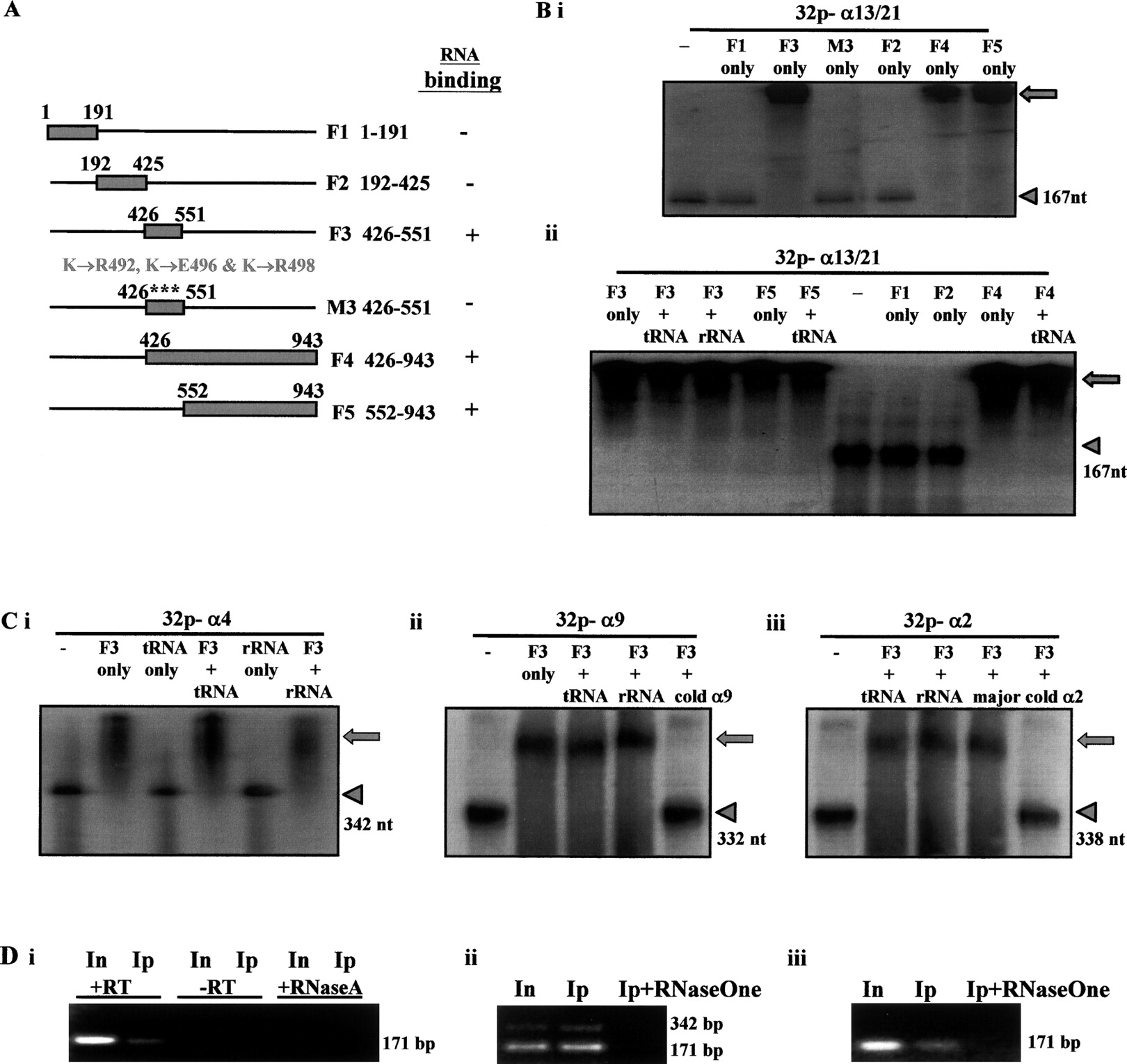
RNA-binding properties of CENPC1 and the kinetochore. (A) Schematic representation of the different recombinant GST-CENPC1 constructs. (F1–F5) GST-CENPC1 recombinant fragments corresponding to amino acids 1–191, 192–425, 426–551, 426–943, and 552–943, respectively; (M3) a GST-CENPC1 recombinant fragment corresponding to F3426–551 but containing three mutational substitutions: K492 → R492, K496 → E496, and K498 → R498. Plus and minus signs indicate positive and negative α-satellite RNA binding, respectively (see B). (B) RNA binding assay. (i) Direct incubation of 0.25 μg of radioactively labeled single-stranded α13/21-satellite RNA probes (167 nt in size) with recombinant GST-CENPC1 fragments resulted in a band shift of the labeled RNA (arrowhead) away from its expected position to a significantly larger size (arrow) for fragments F3, F4, and F5 (but not F1, F2, and M3), indicating a positive RNA-binding property for fragments F3, F4, and F5. (ii) The addition of 2 μg of tRNA or rRNA as a competitor has no significant effects on the binding of these proteins to the labeled α-satellite RNA probes. (C) Direct incubation of 0.25 μg of radioactively labeled single-stranded α4 (Ci), α9 (Cii), and α2 (Ciii) satellite RNA probes (342, 332, and 338 nt in size, respectively) with recombinant GST-CENPC1 fragment F3 resulted in a band shift of the labeled RNA (arrowhead) away from its expected position to a significantly larger size (arrow). The addition of 2 μg of tRNA, rRNA, and AT-rich mouse pericentric major satellite as a competitor has no significant effects on the binding of these proteins to the labeled α-satellite RNA probes. However, the addition of 2 μg of cold α9 (Cii) and α2 (Ciii) resulted in loss of band shift. (D) Detection of CENPC1-associated RNA following CENPC1-mediated RNA-ChIP. α-Satellite PCR primers used were specific for chromosome 13/21 (i,ii) or chromosome 4 (iii). RNA was detected as a 171-bp cDNA band (corresponding to an α-satellite monomer) using RT-PCR in the CENPC1-mediated RNA-ChIP sample (Ip) and in the total genomic input DNA (In). In some experiments where the number of PCR cycle was increased from 25 to 30, a 171-bp ladder could be seen (e.g., ii). The absence of products when no reverse transcriptase was added (−RT) or following pretreatment of samples with either RNaseA or RNaseOne for 10 min at room temperature indicated that the RT-PCR products were derived from immunoprecipitated RNA, and not DNA.



