


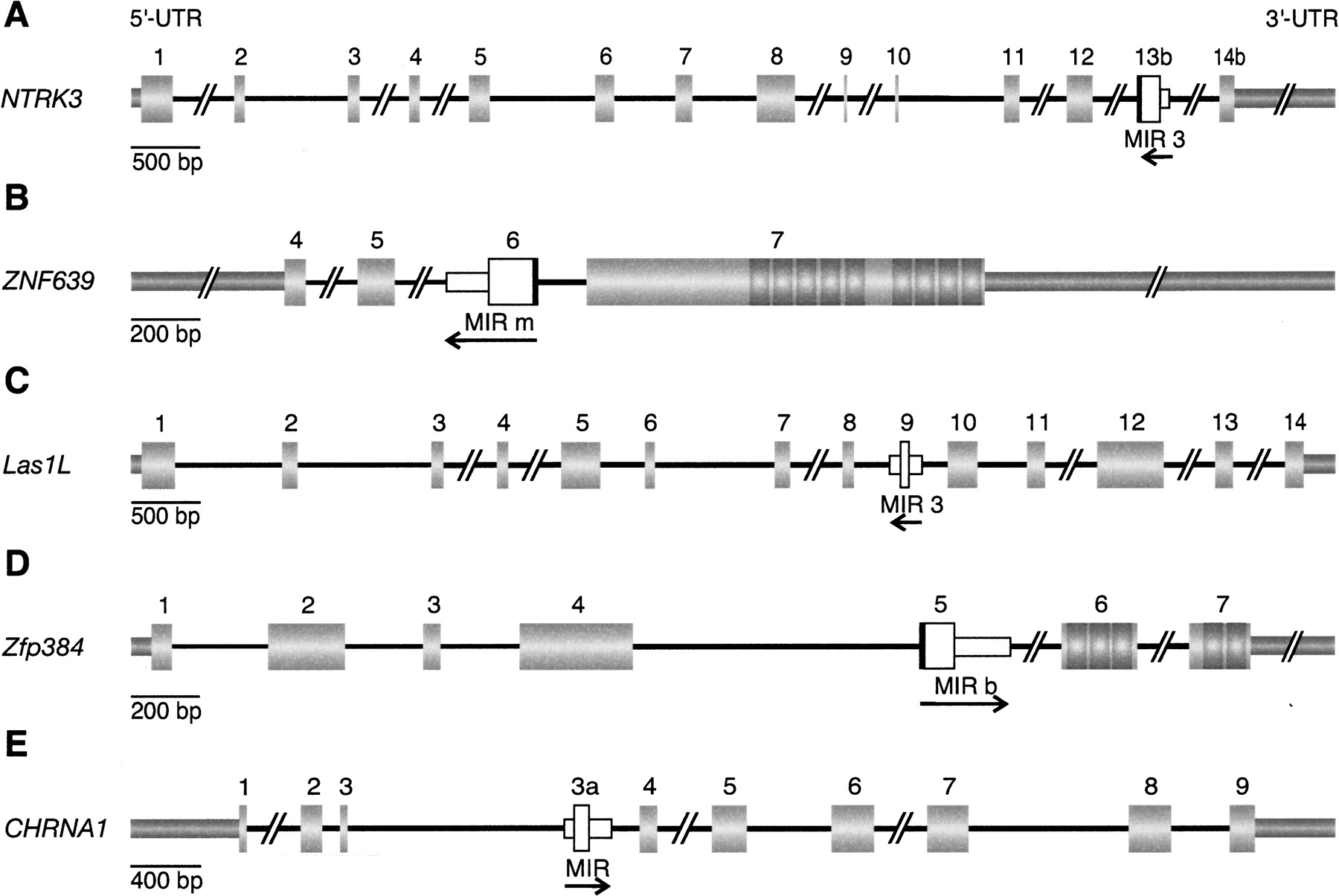
Structures of five selected genes harboring internal exonized MIR elements. Numbered, thick gray boxes represent protein-coding sequences (CDS). The 5′ and 3′ untranslated regions (UTRs) are shown as medium thick gray bars. Introns are indicated as black lines; double slashes denote gaps in larger introns. Orientations and recognizable lengths of the MIR elements are indicated by arrows. The short white boxes represent the intronic parts of the MIR elements, and the adjacent tall white boxes the exonized regions. In three cases the exonization exceeds the MIR boundaries and includes anonymous intronic sequences (black bars adjacent to the exonized regions). (A) Human neurotrophic tyrosine kinase receptor type 3 gene (NTRK3; BT007291). (B) Human zinc finger protein 639 gene (ZNF639; NM_016331). (C) Human LAS1-like gene (LAS1L; NM_031206). (D) Rat zinc finger protein 384 gene (Zfp384; AF216807). (E) Human cholinergic receptor nicotinic alpha1 gene (CHRNA1; NM_001039523). The substructures in exon 7 of ZNF639 and in exons 6 and 7 of Zfp384 represent sequences encoding zinc finger domains.


