


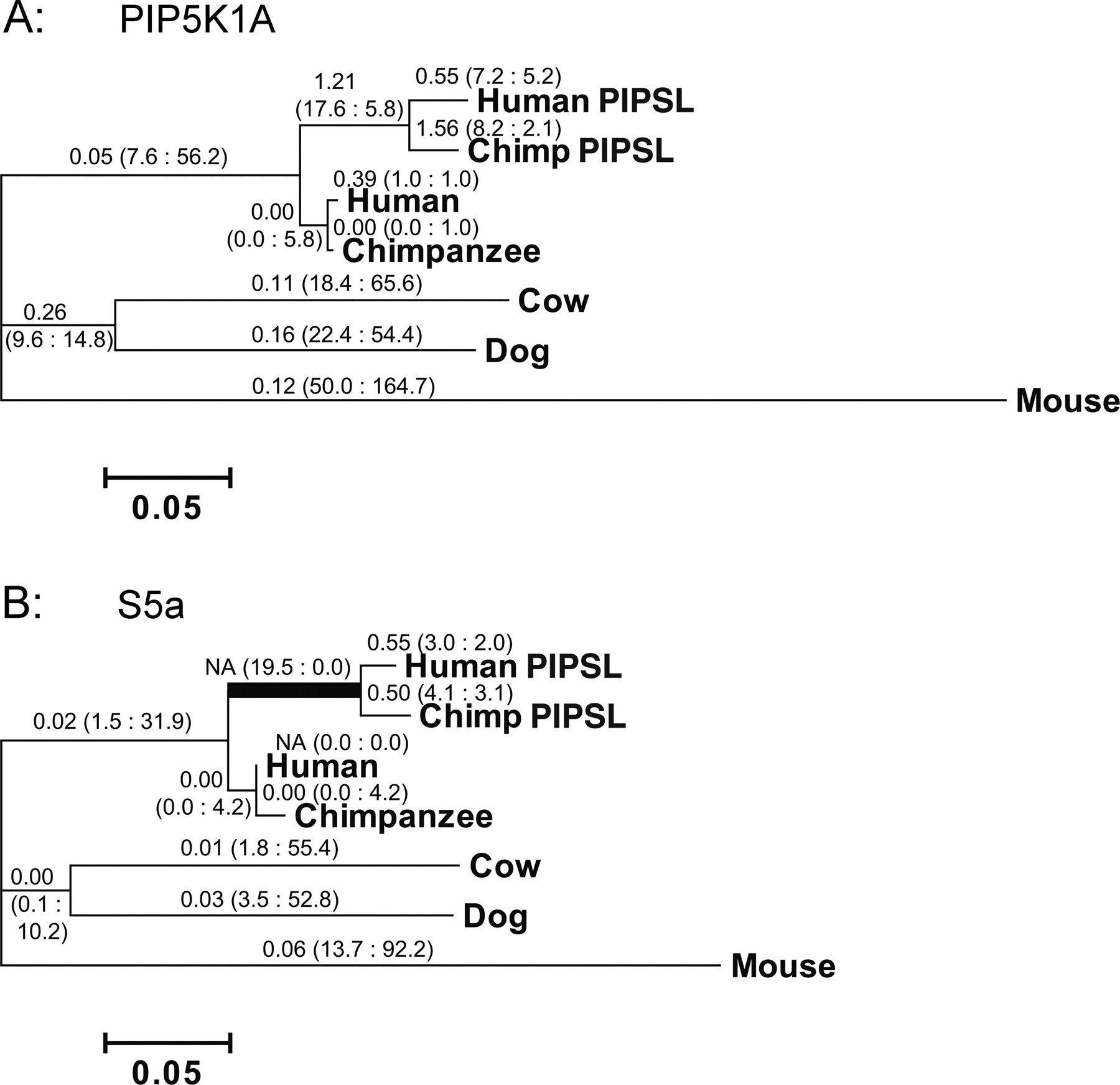
PIPSL experienced a burst of positive selection shortly after its creation (A). The phylogenetic tree of the PIP5K1A region (A) and the S5a region of the PIPSL gene (B). Branches are drawn in proportion to the total number of substitutions incurred, with nonsynonymous-to-synonymous substitution rate ratios (Ka/Ks), and the nonsynonymous (n) and synonymous (s) substitutions in parentheses (n : s) shown above each branch. Nineteen nonsynonymous and 0 synonymous changes occurred in the S5a region of PIPSL along the branch leading to the human/chimp split (B, indicated by bold line). The n/s ratio is significantly greater than its neutral expectation (P = 0.0018, Fisher’s exact test; Table 1), indicating that the PIPSL gene was under strong positive selection shortly after its formation. (NA) Not applicable (Ks = 0).



