


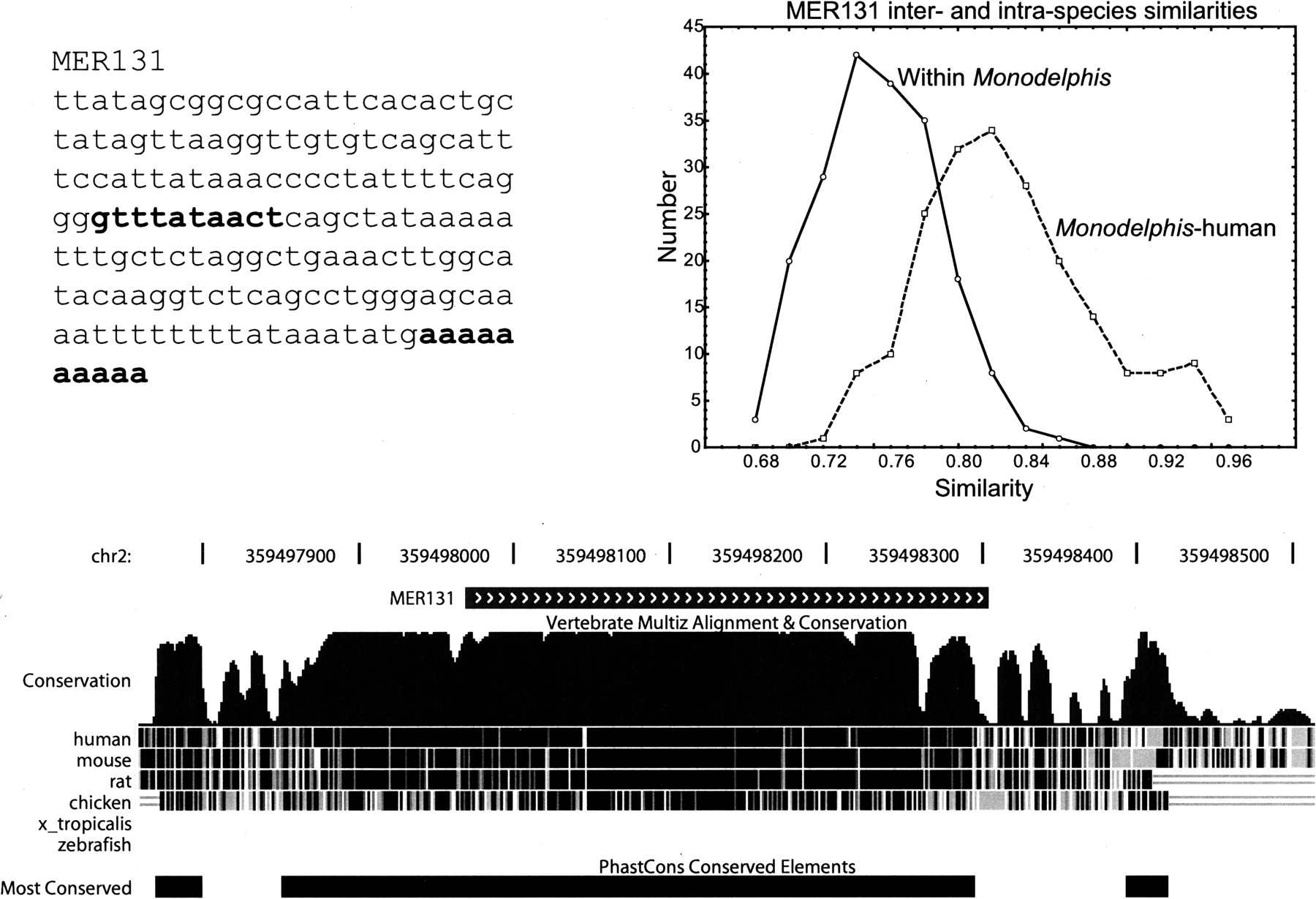
Sequence and conservation of the exapted SINE element MER131. (Top left) The MER131 consensus sequence. The putative Box-B promoter and poly(A) tail are highlighted in bold. (Top right) The distribution of pairwise similarities of the 200 most conserved MER131 sequences both within Monodelphis, and syntenic regions of Monodelphis-human. (Bottom) A MER131 insertion on chromosome 2, with 100-bp flanking sequence either side and degree of conservation across Monodelphis, human, mouse, rat, and chicken (the region shown is chr2: 359,497,570–359,498,703 from the UCSC genome browser Opossum January 2006 assembly). The MultiZ alignment score across all species is shown in black. Gray shaded areas are phastCons scores between Monodelphis and the individual species. The blocks labeled “Most Conserved” are predicted by phastCons (Siepel et al. 2005).



